Annex IV MEASUREMENT OF THE SIZE OF A MARINE ORGANISMF1
United Kingdom
- 1..
The size of any fish shall be measured, as shown in Figure 1, from the tip of the snout to the end of the tail fin.
- 2..
The size of a Norway lobster (Nephrops norvegicus) shall be measured, as shown in Figure 2, either:
as the length of the carapace, parallel to the midline, from the back of either eye socket to the midpoint of the distal dorsal edge of the carapace, or
as the total length, from the tip of the rostrum to the rear end of the telson, not including the setae.
In the case of detached Norway lobster tails: from the front edge of the first tail segment present to the rear end of the telson, not including the setae. The tail shall be measured flat, unstretched and on the dorsal side.
- 3..
- 4..
F4. . . . . . . . . . . . . . . . . . . . . . . . . . . . . . . .
- 5..
The size of a crawfish (Palinurus spp.) shall be measured, as shown in Figure 4, as the length of the carapace, parallel to the midline, from the tip of the rostrum to the midpoint of the distal dorsal edge of the carapace.
- 6..
The size of any bivalve mollusc shall be measured, as shown in Figure 5, across the longest part of the shell.
- 7..
The size of a spinous spider crab (Maja squinado) shall be measured, as shown in Figure 6, as the length of the carapace, along the midline, from the edge of the carapace between the rostrums to the posterior edge of the carapace.
- 8..
The size of an edible crab (Cancer pagurus) shall be measured, as shown in Figure 7, as the maximum width of the carapace measured perpendicular to the antero-posterior midline of the carapace.
- 9..
The size of a whelk (Buccinum spp.) shall be measured, as shown in Figure 8, as the length of the shell.
- 10..
F5The size of bluefin tuna (Thunnus thynnus) is measured as the projected straight distance between the tip of the snout and the fork of the tail fin (“fork length”) as shown in Figure 10 and labelled as “FL”.
Figure 1 Fish species

Figure 2 Norway Lobster
(Nephrops norvegicus)

Figure 3 Lobster
(Hommarus gammarus)
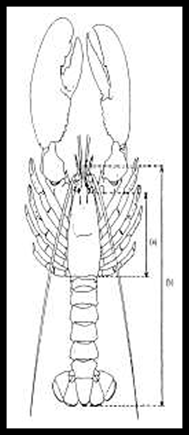
Figure 4 Crawfish
(Palinurus spp.)

Figure 5 Bivalve molluscs

Figure 6 Spinous Spider Crabs
(Maja squinado)

Figure 7 Edible crab
(Cancer pagurus)

Figure 8 Whelk
(Buccinum spp.)

Figure 9 Swordfish
(Xiphias gladius)

Figure 10 Bluefin tuna
(Thunnus thynnus)
Annotations
Textual amendments
- F1
Annex 4 Figure 10 inserted (1.4.2024) by The Sea Fisheries (International Commission for the Conservation of Atlantic Tunas) (Amendment) Regulations 2024 (S.I. 2024/439), reg. 1(1), Sch.
- F2
Words in Annex 4 point 3 omitted (31.12.2020) by virtue of The Common Fisheries Policy and Animals (Amendment etc.) (EU Exit) Regulations 2019 (S.I. 2019/1312), regs. 1(3), 5(33)(a)(i); 2020 c. 1, Sch. 5 para. 1(1)
- F3
Words in Annex 4 point 3 inserted (31.12.2020) by The Common Fisheries Policy and Animals (Amendment etc.) (EU Exit) Regulations 2019 (S.I. 2019/1312), regs. 1(3), 5(33)(a)(ii); 2020 c. 1, Sch. 5 para. 1(1)
- F4
Annex 4 point 4 omitted (31.12.2020) by virtue of The Common Fisheries Policy and Animals (Amendment etc.) (EU Exit) Regulations 2019 (S.I. 2019/1312), regs. 1(3), 5(33)(b); 2020 c. 1, Sch. 5 para. 1(1)
- F5
Annex 4 point 10 (previously omitted by virtue of S.I. 2019/1312, reg. 5(33)(b)) inserted (1.4.2024) by The Sea Fisheries (International Commission for the Conservation of Atlantic Tunas) (Amendment) Regulations 2024 (S.I. 2024/439), regs. 1(1), 8(2)(a)