Original text. legislation.gov.uk does not revise statutory instruments, so later amendments are not shown here. Changes made to it are listed under each provision when known.
LAND REGISTRATION, ENGLAND AND WALES
Made 30th June 2005
Laid before Parliament 7th July 2005
Coming into force 24th October 2005
The Lord Chancellor, with the advice and assistance of the Rule Committee appointed in pursuance of section 127 of the Land Registration Act 2002f1, in exercise of the powers conferred on him by sections 14(a) and (b)(i), 27(6), 43(2)(c) and (d), 66(2), 67(3), 68(2), 69(2), 70, 73(4), 75(2), 76(2), 88, 126, 127(1), 128 and 134(2) of, and paragraphs 5, 6(a), (b) and (c) and 8 of Schedule 10 and paragraph 2(4) of Schedule 12 to, that Act, hereby makes the following rules:
In these rules “the principal rules” means the Land Registration Rules 2003f1 and a reference to a rule by number is a reference to the rule in the principal rules so numbered.
After rule 91, the following rule shall be inserted—
“Completion of standard forms of restriction
91A.
(1)
Subject to paragraphs (2) and (3), where a standard form of restriction is to affect part only of the registered estate, then, where it refers to a disposition, or to a disposition of a specified type, to which it applies, that reference may be followed by the words “of the part of the registered estate” together with a sufficient description, by reference to a plan or otherwise, to identify clearly the part so affected.
(2)
The words incorporated pursuant to paragraph (1) shall be in place of the words “of the registered estate” where those latter words appear in a standard form of restriction and are referring to a disposition, or to a disposition of a specified type, to which the restriction applies.
(3)
The registrar may alter the words of any restriction affecting part of the registered estate only that he intends to enter in the register so that such part is described by reference to the relevant title plan or in another appropriate way.
(4)
A restriction in Form L, M, N, O, P, S or T may commence with the word “Until . . . ” followed by a calendar date.”.
In paragraph (u), the final “and” shall be deleted.
(3)
In paragraph (v), the full stop shall be replaced by “, and”.
(4)
After paragraph (v), the following paragraph shall be inserted—
“(w)
the Legal Services Commission where it has a statutory charge, created by section 16(6) of the Legal Aid Act 1988f1 or by section 10(7) of the Access to Justice Act 1999f2, over a beneficial interest in registered land held under a trust of land and is applying for a restriction in Form JJ to be entered in the register of that land.”.
After rule 140(4), the following paragraph shall be inserted—
“(4A)
A qualifying applicant who applies for a search in the index of proprietors' names under paragraph (2) may apply at the same time in the Form CIT attached to the Form PN1 for official copies of every individual register referred to in the entries (if any) in the index relating to the particulars given in the search application.”.
In rule 217(1), the definition of “conveyancer” shall be amended as follows—
(a)
after “Executives,” in (c) of the definition there shall be inserted the word “or (d) a duly certificated notary public,” and
(b)
after the words “licensed conveyancer” where they last appear in the definition, there shall be substituted for the words from “or” to “Executives”—“, fellow of the Institute of Legal Executives or duly certificated notary public”.
(2)
In rule 217(3), for “Forms AA to HH” there shall be substituted “Forms AA to LL”.
After the word “consent” in the headings to Forms N and T, after the words “specified title number” in the heading to Form O and after the words “specified charge” in Form P there shall be added the words “or certificate”.
In Forms N and T, “[signed by [name] of [address] (or [his conveyancer] or specify appropriate details)]” shall be replaced by “[signed by [name] of [address] [or [his conveyancer] or specify appropriate details]]”.
In Forms EE and FF, the words “(name of the prosecutor or other person who applied for the order)” shall be replaced by the words “(name of prosecutor or other appropriate person) of (address)”.
In Forms GG and HH, the words “(name of the prosecutor or other person applying)” shall be replaced by the words “(name of prosecutor or other appropriate person) of (address)”.
There shall be inserted, at the appropriate places, and in the columns indicated below—
“
Column 1
Column 2
An accredited financial investigator falling within section 378(1)(b) of the Proceeds of Crime Act 2002f1
Certificate H
An accredited financial investigator falling within section 378(4)(a) of the Proceeds of Crime Act 2002
Certificate N
A person authorised to apply by the Commissioners for Her Majesty’s Revenue and Customs and having the consent of a General/Special Commissioner to make the application
Certificate L
The Director of Revenue and Customs Prosecutions or a member of the Revenue and Customs Prosecutions Office authorised to apply on behalf of the Director
Certificate A
Certificate B
Certificate C
Certificate D
Certificate E
Certificate H
The Director General of the National Crime Squad or a member of the National Crime Squad authorised to apply on behalf of the Director General
Certificate O
The Director General of the National Criminal Intelligence Service or a member of the National Criminal Intelligence Service authorised to apply on behalf of the Director General
In column 2 against “The Lord Advocate” (in column 1) and below “Certificate D”, there shall be inserted “Certificate H” and, below that, “Certificate N”.
These rules amend the Land Registration Rules 2003 (the principal rules).
Rule 1 provides for citation and commencement and rule 2 for interpretation.
Rule 3 makes a consequential amendment to rule 91(1) of the principal rules, arising from rule 4.
Rule 4 adds a new rule, rule 91A to the principal rules. This allows a number of standard forms of restriction to refer to dispositions of a specified part of the registered estate. It also allows standard forms of restriction in Forms L, M, N, O, P, S or T to commence with the word “Until”.
Rules 5 and 8 amend rules 92(2) and 198(2)(d) of the principal rules respectively. The amendments to rule 198(2)(d) provide that a person named in a standard form of restriction set out in Schedule 4 to the principal rules must provide an address for service where an address is required by that restriction; so must a person named in any other restriction that requires his consent, certificate or the giving of notice to him. The amendment to rule 92(2) of the principal rules makes it clear that the requirement for the application for entry of a restriction to be accompanied by a person’s address for service only applies to a person within rule 198(2)(d).
Rule 6 amends rule 93 of the principal rules to provide that the Legal Services Commission shall be regarded as having a sufficient interest in the entry of a restriction in Form JJ (a Form prescribed under these Rules) in the circumstances specified.
Rule 7 adds a paragraph to rule 140 of the principal rules to allow a qualifying applicant who applies for a search in the index of proprietors' names to apply at the same time, in the Form CIT attached to the Form PN1, for official copies of the registers identified in the results of that search.
Rule 9(1) widens the definition of “conveyancer” in rule 217(1) of the principal rules to include a duly certificated notary public.
Rule 9(2) amends rule 217(3) of the principal rules to take account of the amendments made by rule 12 and Schedule 3 to these Rules.
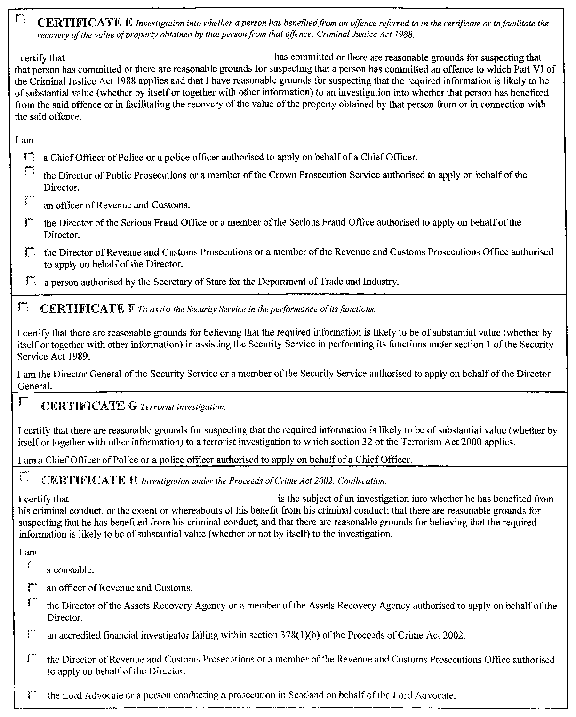
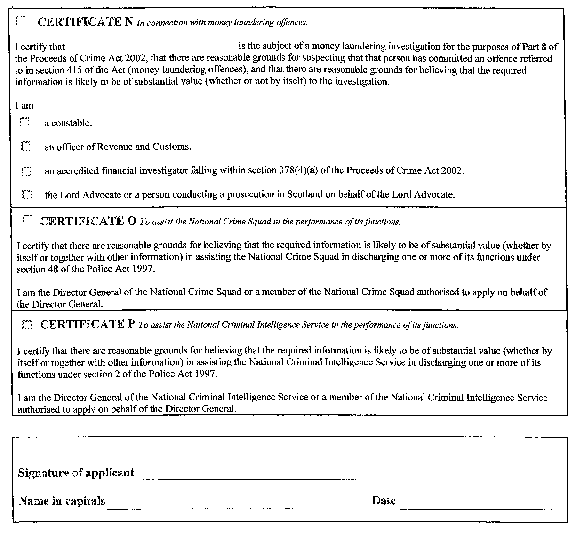
Rule 10 and Schedule 1 substitute a new Form CIT in Schedule 1 to the principal rules to take account of rules 7 and 12.
Rule 11 and Schedule 2 amend the standard forms of restriction contained in Schedule 4 to the principal rules and prescribe a number of additional standard forms of restriction.
Rule 12 and Schedule 3 amend Schedule 5 to the principal rules to include accredited financial investigators, and the Directors General and authorised members of the National Criminal Intelligence Service and the National Crime Squad, as qualifying applicants, for the purpose of rule 140 of the principal rules, where they give the appropriate certificate in the new Form CIT substituted by rule 10. These provisions also amend Schedule 5 to take account of the establishment of Her Majesty’s Revenue and Customs and the Revenue and Customs Prosecutions Office by the Commissioners for Revenue and Customs Act 2005.
A Regulatory Impact Assessment has been prepared and placed in the library of each House of Parliament. Copies can be obtained from the Land Registry, 32 Lincoln’s Inn Fields, London WC2A 3PH.