The Local Authorities (Capital Finance and Accounting) (England) (Amendment) Regulations 2020
S.I. 2020/1212 · Made 4 November 2020
Original text. legislation.gov.uk does not revise statutory instruments, so later amendments are not shown here. Changes made to it are listed under each provision when known.
Local Government, England
Made 4th November 2020
Laid before Parliament 6th November 2020
Coming into force 29th November 2020
The Secretary of State, in exercise of the powers conferred by sections 21(1) and 123(1) and (2) of the Local Government Act 2003f1, makes the following Regulations.
After regulation 30K of the Local Authorities (Capital Finance and Accounting) (England) Regulations 2003f1 insert—
“Deficit relating to schools budget
30L
(1)
This regulation applies in relation to accounts prepared for the financial years beginning on 1st April 2020, 1st April 2021 and 1st April 2022.
(2)
In this regulation—
“Dedicated Schools Grant” means the grant of that name paid to a local authority by the Secretary of State under section 14 of the Education Act 2002f2;
“schools budget” has the meaning given in section 45A(2) of the School Standards and Framework Act 1998f3;
“sixth form grant” means a grant of that name paid to a local authority by the Secretary of State under section 14 of the Education Act 2002 in respect of sixth form pupils.
(3)
Where a local authority has a deficit in respect of its schools budget for a financial year beginning on 1st April 2020, 1st April 2021 or 1st April 2022, the authority—
(a)
must not charge to a revenue account an amount in respect of that deficit; and
(b)
must charge the amount of the deficit, calculated in accordance with paragraph (4) or (5), to an account established, charged and used solely for the purpose of recognising deficits in respect of its schools budget.
(4)
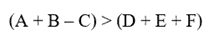
A local authority has a deficit in respect of its schools budget for the financial year beginning on 1st April 2020 if—
where—
A is the amount of the authority’s expenditure incurred on the schools budget for the financial year beginning on 1st April 2020, recognised in accordance with proper practicesf4;
B is the amount of the authority’s accumulated outstanding deficit, if any, in respect of the schools budget, recognised in the authority’s accounts relating to the financial year beginning on 1st April 2019, in accordance with proper practices;
C is the amount, if any, that the authority transfers from its general fundf5 in respect of its schools budget expenditure in the financial year beginning on 1st April 2020;
D is the amount of the authority’s Dedicated Schools Grant in the financial year beginning on 1st April 2020, recognised in accordance with proper practices;
E is the amount of the authority’s accumulated surplus, if any, in respect of the schools budget, recognised in the authority’s accounts relating to the financial year beginning on 1st April 2019, in accordance with proper practices;
F is the amount of the authority’s sixth form grant in the financial year beginning on 1st April 2020, recognised in accordance with proper practices.
(5)
An authority has a deficit in respect of its school budget for a financial year beginning on 1st April 2021 or 1st April 2022 if—
where—
G is the amount of the authority’s expenditure incurred on the schools budget for the financial year to which the accounts relate, recognised in accordance with proper practices;
H is the amount, if any, that the authority transfers from its general fund in respect of its schools budget expenditure in the financial year to which the accounts relate;
I is the amount of the authority’s Dedicated Schools Grant in the financial year to which the accounts relate, recognised in accordance with proper practices;
J is the amount of the authority’s accumulated surplus, if any, in respect of the schools budget, carried forward from the preceding financial year, recognised in accordance with proper practices;
K is the amount of the authority’s sixth form grant in the financial year to which the accounts relate, recognised in accordance with proper practices.”.
The Local Authorities (Capital Finance and Accounting) (England) Regulations 2003 (“the 2003 Regulations”) make provision about the accounting practices to be followed by local authorities, including (in particular) with respect to the charging of expenditure to revenue accounts.
These Regulations insert new regulation 30L into the 2003 Regulations. New regulation 30L provides that where a local authority has a deficit on its school budget, the authority must not charge any such deficit to its revenue account. Instead, new regulation 30L provides that local authorities must charge any such deficit to a separate account, established and usable solely for that purpose.
New regulation 30L will apply to accounts prepared for the financial years beginning in 2020, 2021 and 2022, and provides formulas for calculating whether a local authority has a schools budget deficit in relation to each such financial year.
A full regulatory impact assessment has not been produced for this instrument as no impact on the private or voluntary sectors is foreseen.