Part 4 Road markingsI1F1F2
England, Wales and Scotland
Sign table — Schedule 11, Part 4
(1) Item | (2) Description and diagram | (3) Permitted or required variants in Part 5 | (4) Requirements applicable in Part 6 |
|---|---|---|---|
| 1 | Diagram 1003.1 Vehicular traffic approaching a roundabout should give way at or immediately beyond the line to vehicular traffic circulating on the carriageway of the roundabout 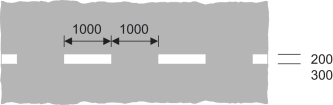 | 7 | |
| 2 | Diagram 1004 Vehicular traffic should not cross or straddle the line unless it is safe to do so and when the line is used to indicate a cycle lane, motor vehicles should not enter that lane unless it is clear of pedal cycles F3and electric scooters being used in a trial (Longitudinal marking) 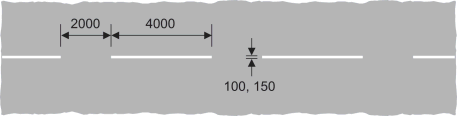 | 57 | 7, 8, 10, 12 |
| 3 | Diagram 1004.1 Vehicular traffic should not cross or straddle the line unless it is safe to do so and when the line is used to indicate a cycle lane, motor vehicles should not enter that lane unless it is clear of pedal cycles and electric scooters being used in a trial (Longitudinal marking) 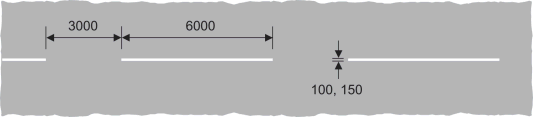 | 7, 8, 10, 12 | |
| 4 | Diagram 1005 Division of carriageway into traffic lanes on part of the carriageway where vehicles normally proceed in the same direction other than at places where the marking at item 2 of this table is used (Longitudinal marking) 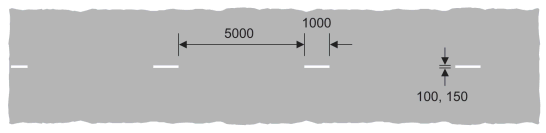 | 7, 8, 10, 12 | |
| 5 | Diagram 1005.1 As the marking at item 4 other than at places where the marking at item 3 is used (Longitudinal marking) 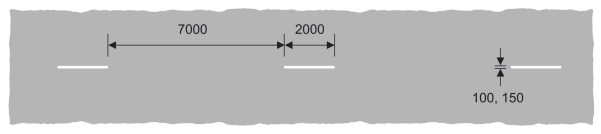 | 7, 8, 10, 12 | |
| 6 | Diagram 1008 Division between opposing flows of traffic on a carriageway other than at places where the marking at item 2 is used (Longitudinal marking) 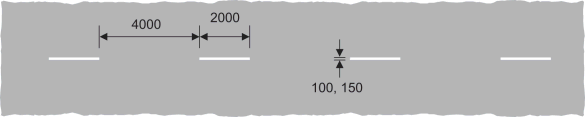 | 57 | 7, 8, 10, 12 |
| 7 | Diagram 1008.1 Division between opposing flows of traffic on a carriageway other than at places where the marking at item 3 is used (Longitudinal marking) 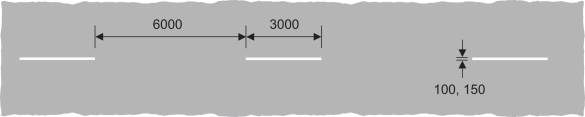 | 7, 8, 10, 12 | |
| 8 | Diagram 1009A Edge of the carriageway at a road junction, exit from a private drive onto a public road, or the start of a cycle lane (Longitudinal marking) 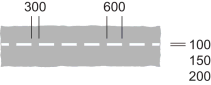 | 7 | |
| 9 | Diagram 1009B Edge of the carriageway at a junction of a cycle track F4, or a way that would be a cycle track but for it being accessible, under a temporary statutory provision, by electric scooters being used in a trial, and another road (Longitudinal marking) 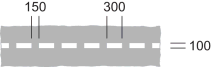 | ||
| 10 | Diagram 1010 (a) edge of the carriageway at a road junction or a lay-by, or at an exit from a private drive onto a public road; (b) the start of a traffic lane, the boundary of which is indicated by the road marking shown at item 11 of the table in Part 6 of Schedule 9; (c) when used in conjunction with the road marking at item 4 of the sign table in Part 4 of Schedule 2, the most suitable path to be taken by high vehicles under a low bridge or to avoid an overhanging structure; (d) when laid alongside rails used by tramcars, the edge of the part of the carriageway used by the tramcars; (e) the division between the main carriageway and a traffic lane which leaves the main carriageway at a junction ahead; (f) the boundary between the main carriageway and either a diverging or merging traffic lane at a road junction; (g) the boundary between an emergency refuge area and either an actively managed hard shoulder or the edge of carriageway of a motorway; or (h) the division between the main carriageway and a cycle lane through a junction (Longitudinal marking) 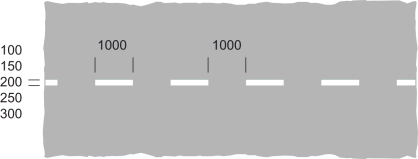 | 41 | 7, 8, 11, 12 |
| 11 | Diagram 1012.1 (a) edge of the carriageway available for through traffic other than at a road junction, an exit from a private drive onto a public road, lay-by or emergency refuge area; (b) the back edge of a hard shoulder; (c) the edge of a footway where it passes over a railway or tramway level crossing; or (d) the boundary between the carriageway of a motorway and an actively managed hard shoulder (Longitudinal marking) 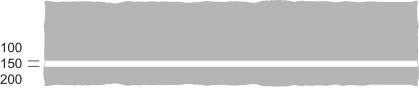 | 7, 9, 11, 12 | |
| 12 | Diagram 1012.2 (a) edge of carriageway of a motorway other than at an emergency refuge area or a junction with a slip road; or (b) the back edge of an actively managed hard shoulder; and, in both cases, incorporating an audible and tactile warning (Longitudinal marking) 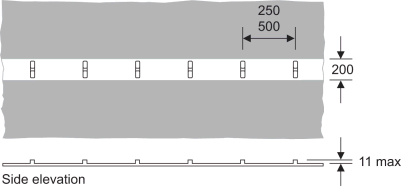 | 42 | 3, 7, 9, 11, 12 |
| 13 | Diagram 1012.3 Edge of carriageway of a road that is not a motorway and which has hard strips or hard shoulders, other than at a junction with a slip road, and incorporating an audible and tactile warning (Longitudinal marking) 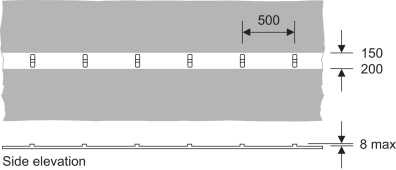 | 43 | 3, 7, 9, 11, 12 |
| 14 | Diagram 1014 (a) Direction in which vehicular traffic should pass a road marking shown at item 7, 11 or 23 of the sign table in Part 6 of Schedule 9 or at item 23, 24 or 25 of the sign table in Part 4 of this Schedule; (b) obstruction on the carriageway ahead; (c) reduction in the number to traffic lanes in the carriageway ahead; or (d) path to be taken by vehicular traffic to avoid a route available for tramcars only (Longitudinal marking) (Alternative types) 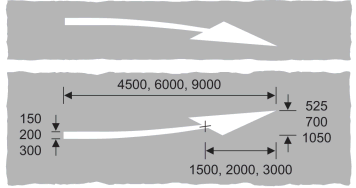 | 7 | |
| 15 | Diagram 1024 Vehicular traffic should proceed with caution because of potential danger ahead 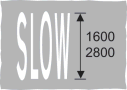 | 7 | |
| 16 | Diagram 1026 Part of the carriageway which should be kept clear of stationary vehicles (Alternative types) 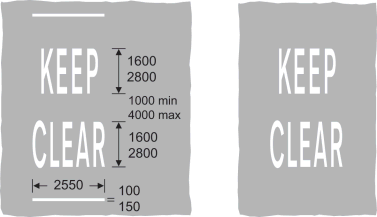 | ||
| 17 | Diagram 1026.1 Part of the carriageway outside a vehicular entrance to adjacent premises or a private drive, or where the kerb is dropped to provide a convenient crossing place for pedestrians, which should be kept clear of waiting vehicles 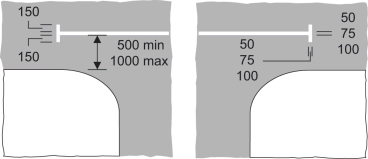 | ||
| 18 | Diagram 1029 Direction in which pedestrians should look for approaching traffic 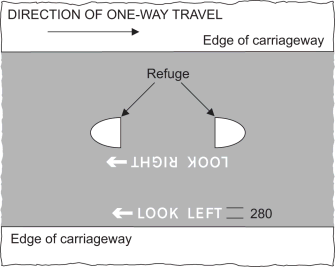 | 44 | |
| 19 | Diagram 1035 Appropriate traffic lanes for different destinations (Alternative types) 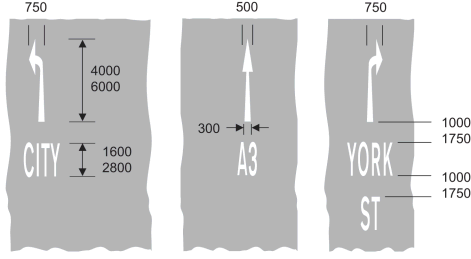 | 45 | |
| 20 | Diagram 1038 Appropriate traffic lanes for different manoeuvres (Longitudinal marking) (Alternative types) 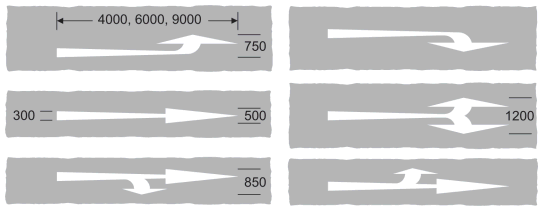 | ||
| 21 | Diagram 1038.1 Appropriate direction to be taken by traffic turning within a junction (Alternative types) 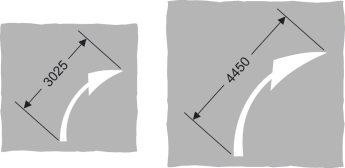 | 46 | |
| 22 | Diagram 1039 Place where traffic streams divide or bifurcate (Longitudinal marking) (Alternative types) 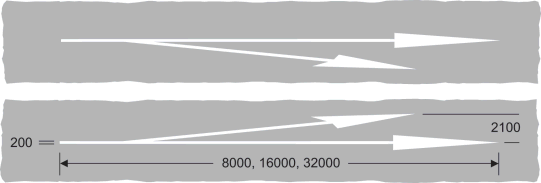 | 7 | |
| 23 | Diagram 1040 Part of the carriageway which vehicular traffic should not enter unless it is seen by the driver to be safe to do so (Alternative types) 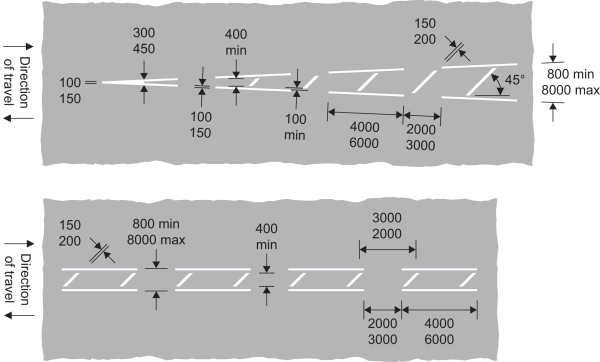 | 47 | 7, 8, 10, 12 |
| 24 | Diagram 1040.3 Reduction in the number of lanes, or area not available to traffic, on the main carriageway or slip road of a motorway or all-purpose dual carriageway road 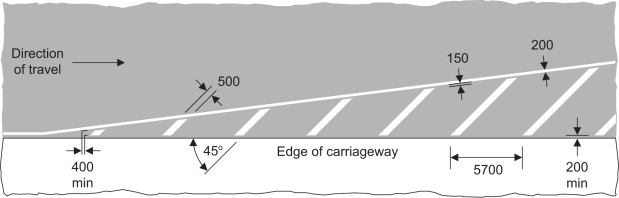 | 48 | 7, 8, 11, 12 |
| 25 | Diagram 1040.4 Part of the carriageway adjacent to the edge which vehicular traffic should not enter unless it is seen by the driver to be safe to do so 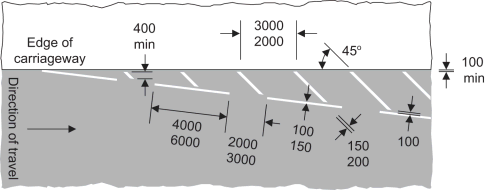 | 49 | 7, 8, 11, 12 |
| 26 | Diagram 1040.5 End of a hard shoulder 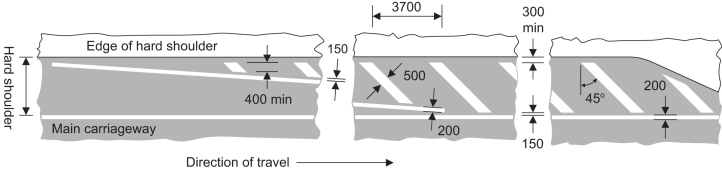 | 50 | 7, 8, 11, 12 |
| 27 | Diagram 1041 Part of the carriageway where vehicular traffic passes in the same direction on both sides of the marking, and should not enter the area covered by the marking unless it is seen by the driver to be safe to do so (Alternative types) 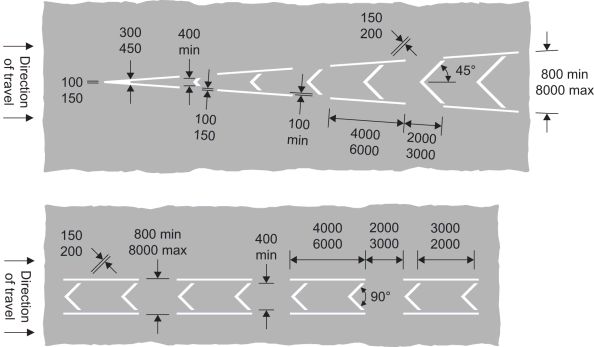 | 51 | 7, 8, 11, 12 |
| 28 | Diagram 1057 Cycle lane, track F5, route, or a way that would be a cycle track but for it being accessible, under a temporary statutory provision, by electric scooters being used in a trial (Alternative types) 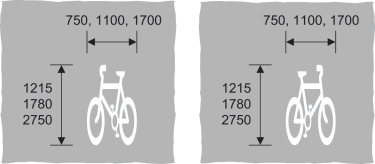 | ||
| 29 | Diagram 1057.1 Number of a cycle route (Alternative types) 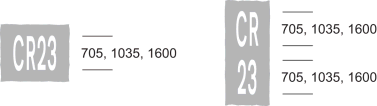 | 29 | |
| 30 | Diagram 1058 End of a cycle lane, track , route, or a way that would be a cycle track but for it being accessible, under a temporary statutory provision, by electric scooters being used in a trial 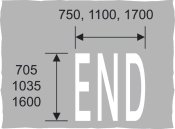 | ||
| 31 | Diagram 1058.1 Pedal cycles and electric scooters being used in a trial should proceed with caution because of potential danger ahead 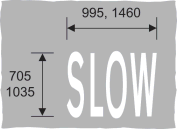 | ||
| 32 | Diagram 1059 Directions in which pedal cycles and electric scooters being used in a trial should travel along a cycle lane, track , route, or a way that would be a cycle track but for it being accessible, under a temporary statutory provision, by electric scooters being used in a trial (Alternative types) 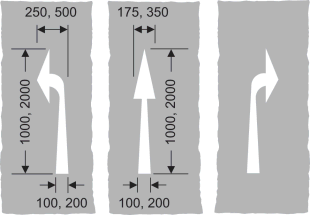 | ||
| 33 | Diagram 1062 Road hump 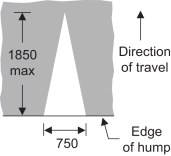 | 7 | |
| 34 | Diagram 1064 Marking used in conjunction with the sign shown at item 50 of the sign table in Part 2 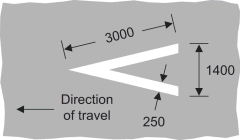 | 7 | |
| 35 | Diagram 1067 Transverse yellow bar markings for use only on approaches to roundabouts on motorways and dual carriageway roads subject to the national speed limit, either on the main carriageway or on an exit slip road 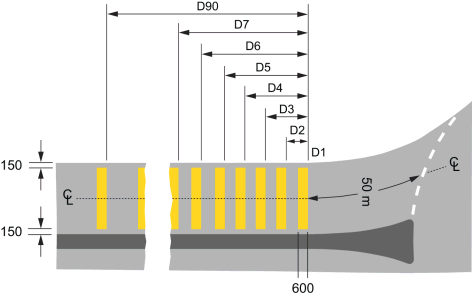 | 52 | 14, 15 |
| 36 | Diagram 1066 Edge of part of the road used by tramcars (Longitudinal marking) 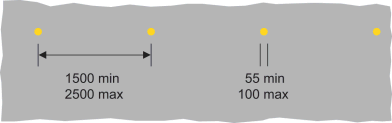 |
Annotations
Textual amendments
- F1
Words in Sch. 11 Pt. 4 heading substituted (S.) (28.6.2018) by The Traffic Signs Amendment (Scotland) Regulations and General Directions 2018 (S.S.I. 2018/161), regs. 1(2), 11(3)
- F2
Words in Sch. 11 Pt. 4 heading substituted (E.W.) (13.12.2017) by The Traffic Signs (Amendment) (England and Wales) Regulations and General Directions 2017 (S.I. 2017/1086), regs. 1(2), 11(3)
- F3
Words in Sch. 11 Pt. 4 Table inserted (E.) (4.7.2020) by The Electric Scooter Trials and Traffic Signs (Coronavirus) Regulations and General Directions 2020 (S.I. 2020/663), regs. 1(2), 5(8)
- F4
Words in Sch. 11 Pt. 4 Table inserted (E.) (19.2.2021) by The Traffic Signs (Coronavirus) (Amendment) (England) Regulations 2021 (S.I. 2021/75), regs. 1(1), 2(12)(a)
- F5
Words in Sch. 11 Pt. 4 Table substituted (E.) (19.2.2021) by The Traffic Signs (Coronavirus) (Amendment) (England) Regulations 2021 (S.I. 2021/75), regs. 1(1), 2(12)(b)
Commencement
- I1
Sch. 11 Pt. 4 in force at 22.4.2016, see reg. 1(b)