Part 2 Warning signs and associated platesI1
England, Wales and Scotland

Sign table — Schedule 2, Part 2
(1) Item | (2) Description | (3) Diagram | (4) First associated plate legend | (5) Supplementary associated plate (by reference to Part 3 sign table item number) | (6) Applicable provisions in Part 7 | (7) Schedule 2 General Directions |
|---|---|---|---|---|---|---|
| 1 | Diagram 504.1 Crossroads ahead (Alternative types) |  | A distance | 1 | 3 | |
| 2 | Diagram 505.1 T-junction ahead (Alternative types) |  | A distance | 1 | 3 | |
| 3 | Diagram 506.1 Side road ahead (Alternative types) | 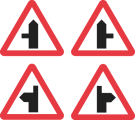 | A distance | 1 | 3 | |
| 4 | Diagram 507.1 Staggered junction ahead (Alternative types) |  | A distance | 1 | 3 | |
| 5 | Diagram 508.1 Traffic merges ahead from left |  | A distance | |||
| 6 | Diagram 509.1 Traffic merges ahead onto main carriageway |  | A distance | |||
| 7 | Diagram 510 Roundabout ahead |  | 1. A distance; or 2. “Adverse camber” | 1 or 4 (or both) | 3 | |
| 8 | Diagram 512 Bend ahead (Alternative types) |  | 1. “Adverse camber”; 2. “Keep in low gear”; or 3. “Oncoming vehicles in middle of road” | 1, 2 or 4 (or any combination) | 3 | |
| 9 | Diagram 512.1 Junction on the outside of a bend ahead (Alternative types) |  | 1. “Adverse camber”; 2. “Keep in low gear”; or 3. “Oncoming vehicles in middle of road” | 1, 2 or 4 (or any combination) | 3 | |
| 10 | Diagram 512.2 Junction on the inside of a bend ahead (Alternative types) |  | 1. “Adverse camber”; 2. “Keep in low gear”; or 3. “Oncoming vehicles in middle of road” | 1, 2 or 4 (or any combination) | 3 | |
| 11 | Diagram 512.3 Crossroads on a bend ahead (Alternative types) |  | 1. “Adverse camber”; 2. “Keep in low gear”; or 3. “Oncoming vehicles in middle of road” | 1, 2 or 4 (or any combination) | 3 | |
| 12 | Diagram 513 Double bend or series of bends ahead (Alternative types) |  | 1. “For” and a distance; 2. “Adverse camber”; 3. “Keep in low gear”; or 4. “Oncoming vehicles in middle of road” | 1, 2 or 4 (or any combination) | 3 | |
| 13 | Diagram 516 Road narrows on both sides ahead |  | 1. A distance; 2. “Single file traffic” with or without an arrow pointing to the left or to the right; 3. “Single file traffic” and a distance, with or without an arrow pointing to the left or to the right; 4. “Single file traffic for” and a distance; 5. “Single track road” with or without an arrow pointing to the left or to the right; 6. “Single track road” or “Single track road for” and a distance, with or without an arrow pointing to the left or to the right; or 7. “Oncoming vehicles in middle of road” | 1 | ||
| 14 | Diagram 517 Road narrows on one side ahead (Alternative types) |  | 1. A distance; 2. “Single file traffic” with or without an arrow pointing to the left or to the right; 3. “Single file traffic” and a distance, with or without an arrow pointing to the left or to the right; 4. “Single file traffic for” and a distance; 5. “Single track road” with or without an arrow pointing to the left or to the right; 6. “Single track road” or “Single track road for” and a distance, with or without an arrow pointing to the left or to the right; or 7. “Oncoming vehicles in middle of road” | 1 | ||
| 15 | Diagram 520 Dual carriageway road ends ahead |  | 1. A distance; 2. “Single file traffic”, with or without a distance; or 3. “Single file traffic for” and a distance | 1 | ||
| 16 | Diagram 521 Two-way traffic ahead |  | 1. A distance; or 2. “For” and a distance | |||
| 17 | Diagram 522 Two-way traffic on route crossing ahead |  | A distance | |||
| 18 | Diagram 523.1 Steep hill downwards ahead |  | 1. A distance with or without an arrow pointing to the left or to the right; 2. “For” and a distance ; 3. An arrow pointing to the left or to the right; 4. “Low gear now”; 5. “Keep in low gear”; or 6. “Low gear for” and a distance | 1 or (when used with a first plate containing legend 4 or 5): 3, or both 1 and 3 | 12 | |
| 19 | Diagram 524.1 Steep hill upwards ahead |  | 1. A distance with or without an arrow pointing to the left or to the right; 2. “For” and a distance; 3. An arrow pointing to the left or to the right; 4. “Low gear now”; 5. “Keep in low gear”; or 6. “Low gear for” and a distance | 1 | 12 | |
| 20 | Diagram 528 Hump bridge ahead |  | 1. A distance with or without an arrow pointing to the left or to the right; 2. An arrow pointing to the left or to the right; or 3. “Oncoming vehicles in middle of road” | 1 | ||
| 21 | Diagram 529 Opening or swing bridge ahead |  | 1. A distance with or without an arrow pointing to the left or to the right; or 2. An arrow pointing to the left or to the right | |||
| 22 | Diagram 529.1 Tunnel ahead |  | 1. A distance with or without an arrow pointing to the left or to the right; 2. An arrow pointing to the left or to the right; or 3. “Oncoming vehicles in middle of road” | |||
| 23 | Diagram 544.1 Pedestrians in road ahead |  | 1. A distance with or without an arrow pointing to the left or to the right; 2. An arrow pointing to the left or to the right; or 3. “No footway for” and a distance | |||
| 24 | Diagram 544.2 Frail or disabled pedestrians likely to cross road ahead |  | 1. A distance with or without an arrow pointing to the left or to the right; 2. An arrow pointing to the left or to the right; 3. “Disabled people” or “Blind people” with or without an arrow pointing to the left or to the right; or 4. “Disabled people” or “Blind people” and a distance, with or without an arrow pointing to the left or to the right | |||
| 25 | Diagram 545 F1In relation to England, children going to or from school or playground ahead |  | 1. “School”, “Patrol”, “Playground”, “Disabled children”, “Blind children” or “Deaf children” with or without an arrow pointing to the left or to the right; 2. “School”, “Patrol”, “Playground”, “Disabled children”, “Blind children” or “Deaf children” and a distance with or without an arrow pointing to the left or to the right; or 3 “No footway for” and a distance | 1 | ||
| F225A | Diagram 545.2 In relation to Wales, children going to or from school or playground area |  | 1. In the Welsh text—
2. In the English text—
| 5 | 1 | |
| 26 | Diagram 950 Cycle route ahead (Alternative types) |  | 1. A distance with or without an arrow pointing to the left or to the right; 2. An arrow pointing to the left or to the right; 3. “Cycle crossing” or “Cycles crossing” with or without an arrow pointing to the left or to the right; or 4. “Cycle crossing” or “Cycles crossing” and a distance with or without an arrow pointing to the left or to the right | |||
| 27 | Diagram 548 Cattle likely to be in road ahead |  | “For” and a distance | |||
| 28 | Diagram 549 Sheep likely to be in road ahead |  | “For” and a distance | |||
| 29 | Diagram 550 Wild horses or ponies likely to be in road ahead |  | “For” and a distance | |||
| 30 | Diagram 550.1 Accompanied horses or ponies likely to be in road ahead |  | 1. A distance with or without an arrow pointing to the left or to the right; 2. An arrow pointing to the left or to the right; or 3. “For” and a distance | |||
| 31 | Diagram 550.2 Horse drawn vehicles likely to be in road ahead |  | “For” and a distance | |||
| 32 | Diagram 551 Wild animals likely to be in road ahead |  | “For” and a distance | |||
| 33 | Diagram 551.2 Wild fowl likely to be in road ahead |  | “For” and a distance | |||
| 34 | Diagram 553.1 Agricultural vehicles likely to be in road ahead |  | 1. “Farm traffic”, “Wide vehicles” or “Tractors turning”; or 2. “Farm traffic for”, “Wide vehicles for” or “Tractors turning for” and a distance | 1 | ||
| 35 | Diagram 552 Cattle grid ahead |  | 1. A distance with or without an arrow pointing to the left or to the right; 2. An arrow pointing to the left or to the right; or 3. “Horse drawn vehicles and animals” and an arrow pointing to the left or to the right | |||
| 36 | Diagram 554B Gate ahead |  | 1. A distance with or without an arrow pointing to the left or to the right; or 2. An arrow pointing to the left or to the right | |||
| 37 | Diagram 554C Gates ahead |  | 1. “For” and a distance, with or without an arrow pointing to the left or to the right; or 2. An arrow pointing to the left or to the right | |||
| 38 | Diagram 554 Ford ahead |  | 1. A distance with or without an arrow pointing to the left or to the right; 2. An arrow pointing to the left or to the right; or 3. “Road liable to flooding” with or without an arrow pointing to the left or to the right | |||
| 39 | Diagram 554.1 Risk of brake failure ahead (after passing a ford or before descending a steep gradient) |  | “Keep in low gear” | When used with the first plate, item 3 | ||
| 40 | Diagram 555 Quayside or river bank ahead |  | 1. A distance with or without an arrow pointing to the left or to the right; or 2. An arrow pointing to the left or to the right | |||
| 41 | Diagram 555.1 Water course alongside road ahead (Alternative types) |  | “For” and a distance | |||
| 42 | Diagram 556.1 Soft verges ahead |  | 1. “Soft verges”; or 2. “Soft verges for” and a distance | 1 | ||
| 43 | Diagram 557.1 F3In relation to England, road hump or series of road humps ahead |  | 1. “Hump” or “Humps” with or without an arrow pointing to the left or to the right; 2. “Hump” or “Humps” with two arrows, one pointing to the left and one pointing to the right; 3. “Hump” or “Humps for” and a distance, with or without an arrow pointing to the left or to the right; or 4. “Hump” or “Humps for” and a distance, with two arrows, one pointing to the left and one pointing to the right | 1 | ||
| F443A | Diagram 557.2 In relation to Wales, road hump or series of road humps ahead |  | 1. In the Welsh text—
2. In the English text—
| 5 | 1 | |
| 44 | Diagram 559 Risk of falling or fallen rocks ahead (Alternative types) |  | “For” and a distance | |||
| 45 | Diagram 581 Side winds likely ahead |  | “For” and a distance | |||
| 46 | Diagram 558 Low flying aircraft or sudden aircraft noise likely ahead |  | 1. “For” and a distance; 2. “Gliders”; or 3. “Gliders for” and a distance | |||
| 47 | Diagram 558.1 Low flying helicopters or sudden helicopter noise likely ahead |  | “For” and a distance | |||
| 48 | Diagram 582 Slow moving military vehicles likely to becrossing or in road ahead |  | “For” and a distance | |||
| 49 | Diagram 583 Slow moving vehicles likely on incline ahead |  | “Slow lorries for” and a distance and “mile” or “miles” | 1 | ||
| 50 | Diagram 584 Traffic queues likely on road ahead |  | 1. “Queues likely” with or without an arrow pointing to the left or to the right; or 2. “Queues likely on slip road” with or without an arrow pointing to the left or to the right | 1, 2 | ||
| 51 | Diagram 770 Level crossing with gate or barrier ahead |  | 1. A distance with or without an arrow pointing to the left or to the right; or 2. An arrow pointing to the left or to the right | 6 | ||
| 52 | Diagram 771 Railway level crossing without gate or barrier ahead |  | 1. A distance with or without an arrow pointing to the left or to the right; or 2. An arrow pointing to the left or to the right | 6 | ||
| 53 | Diagram 772 Tramcars crossing ahead |  | 1. A distance with or without an arrow pointing to the left or to the right; or 2. An arrow pointing to the left or to the right | 6 | ||
| 54 | Diagram 779 Electrified overhead cable ahead |  | 1. “Safe height” and numerals indicating height in imperial units and, in brackets, the height in metric units, with or without “load gauge”; or 2. As legend 1 and— (a) a distance; (b) an arrow pointing to the left or to the right; or (c) a distance and an arrow pointing to the left or to the right | 5, 6 | 1 | |
| 55 | Diagram 782 Risk of grounding at a railway or tramway level crossing or hump backed bridge ahead |  | 1. A distance with or without an arrow pointing to the left or to the right; or 2. An arrow pointing to the left or to the right | 6 | ||
| 56 | Diagram 562 Other danger ahead |  | 1.“Ambulance station”, “Blasting”, “Blind summit”, F5“Concealed access”, “Fire station”, “Hidden dip”, “Pedestrians crossing”, F6“Pedestrians and cyclists crossing”, “Road liable to flooding”, or “Rising bollards”, with or without an arrow pointing to the left or to the right; or 2.“Ambulance station”, “Blasting”, “Blind summit”, “Concealed access”, “Fire station”, “Hidden dip”, “Pedestrians crossing”, “Pedestrians and cyclists crossing”, “Road liable to flooding” or “Rising bollards” and a distance, with or without an arrow pointing to the left or to the right | 1 |
Annotations
Textual amendments
- F1
Words in Sch. 2 Pt. 2 Table inserted (W.) (17.9.2023) by The Traffic Signs (Amendment) (Wales) Regulations and General Directions 2023 (S.I. 2023/783), regs. 1(2), 3(1)(a) (with reg. 11)
- F2
Sch. 2 Pt. 2 Table item 25A inserted (W.) (17.9.2023) by The Traffic Signs (Amendment) (Wales) Regulations and General Directions 2023 (S.I. 2023/783), regs. 1(2), 3(1)(b) (with reg. 11)
- F3
Words in Sch. 2 Pt. 2 Table inserted (W.) (17.9.2023) by The Traffic Signs (Amendment) (Wales) Regulations and General Directions 2023 (S.I. 2023/783), regs. 1(2), 3(1)(c) (with reg. 11)
- F4
Sch. 2 Pt. 2 Table item 43A inserted (W.) (17.9.2023) by The Traffic Signs (Amendment) (Wales) Regulations and General Directions 2023 (S.I. 2023/783), regs. 1(2), 3(1)(d) (with reg. 11)
- F5
Words in Sch. 2 Pt. 2 table inserted (S.) (23.5.2022) by The Traffic Signs Amendment (Scotland) Regulations and General Directions 2022 (S.S.I. 2022/111), regs. 1(2), 4(2)(a)
- F6
Words in Sch. 2 Pt. 2 table inserted (S.) (23.5.2022) by The Traffic Signs Amendment (Scotland) Regulations and General Directions 2022 (S.S.I. 2022/111), regs. 1(2), 4(2)(b)
Commencement
- I1
Sch. 2 Pt. 2 in force at 22.4.2016, see reg. 1(b)