Criminal Law Act 1977 in Northern Ireland
1977 c. 45 · Enacted 29 July 1977 · Extends to United Kingdom
Contents
- 11. . . . . . . . . . . . . . . . . . . . . . . . . . . . . . . . Repealed
- 12Supplementary provisions.
- 13Abolitions and repeals.
- Part III: Criminal Procedure, Penalties, etc.
- Penalties
- 32Other provisions as to maximum fines.
- 34, 35. . . . . . . . . . . . . . . . . . . . . . . . . . . . . . . . Repealed
- 36Enforcement of fines imposed on young offenders.
- 37Supervision orders.
- Cross-border enforcement
- 38. . . . . . . . . . . . . . . . . . . . . . . . . . . . . . . . Repealed
- 38AExecution in different parts of United Kingdom of warrants for imprisonment for non-payment of fine.
- 38BFurther provision for execution of warrants of commitment for non-payment of sum adjudged to be paid by conviction in England and Wales or Northern Ireland.
- 39Service of summonses and citation throughout United Kingdom.
- 40Transfer of fine orders.
- 41, 42. . . . . . . . . . . . . . . . . . . . . . . . . . . . . . . . Repealed
- 43. . . . . . . . . . . . . . . . . . . . . . . . . . . . . . . . Repealed
- 45. . . . . . . . . . . . . . . . . . . . . . . . . . . . . . . . Repealed
- Part IV: Miscellaneous Provisions
- 52Misuse of Drugs Act 1971: redefinition of cannabis.
- Part VI: Supplementary
- 65Citation, etc.
- 1Paragraph 1
- 2Paragraph 2 Repealed
- Schedule 7: Transfer of Fine Orders
- 1Paragraph 1 Repealed
- Scotland
- 2Paragraph 2 Repealed
- 3Paragraph 3 Repealed
- 1Paragraph 1
- 2Paragraph 2
- Recall of offender on re-conviction
- 3Paragraph 3
- 3AParagraph 3A
- 4Paragraph 4
- 5Paragraph 5
- 6Paragraph 6
- 7Paragraph 7
- 8Paragraph 8
- 9Paragraph 9
- 10Paragraph 10
- 11Paragraph 11
- 1Paragraph 1
- 2Paragraph 2
- 3Paragraph 3 Repealed
- 4Paragraph 4
- 5Paragraph 5
- 6Paragraph 6 Repealed
- 7Paragraph 7
- 8Paragraph 8
- 9Paragraph 9
- 10Paragraph 10
- 11—13Paragraph 11—13 Repealed
- Schedule 12: Minor and Consequential Amendments
- 1Paragraph 1
- 2Paragraph 2
- . . . . . . . . . . . . . . . . . . . . . . . . . Part . . . . . . . . . . . . . . . . . . . . . . . . .
- 1Paragraph 1
- 2Paragraph 2
- Part CRIMINAL JUSTICE ACT 1961 (c. 39)
- 2Paragraph 2
- 3Paragraph 3
- 4Paragraph 4
- 5Paragraph 5
- 1Paragraph 1 Repealed
- 2Paragraph 2 Repealed
- Part CRIMINAL JUSTICE ACT 1967 (C. 80)
- 7Paragraph 7
- 8Paragraph 8 Repealed
- 1Paragraph 1
- 2Paragraph 2
- 1Paragraph 1 Repealed
- 2Paragraph 2
- 4Paragraph 4
- 5Paragraph 5
- 6Paragraph 6
- 1Paragraph 1
- 2Paragraph 2
- 2Paragraph 2
- 3Paragraph 3
- 5Paragraph 5
- 6Paragraph 6 Repealed
- 10Paragraph 10
- 1Paragraph 1
- 2Paragraph 2
- 3Paragraph 3
- 4Paragraph 4 Repealed
- Schedule 13Schedule 13
- Schedule 14: Transitional Provisions
- 1Paragraph 1
- 5Paragraph 5
11. . . . . . . . . . . . . . . . . . . . . . . . . . . . . . . .F1
12Supplementary provisions.
In this Part of this Act—
“premises” means any building, any part of a building under separate occupation, any land ancillary to a building, the site comprising any building or buildings together with any land ancillary thereto, and (for the purposes only of sections 10 and 11 above) any other place; and
“access” means, in relation to any premises, any part of any site or building within which those premises are situated which constitutes an ordinary means of access to those premises (whether or not that is its sole or primary use).
References in this section to a building shall apply also to any structure other than a movable one, and to any movable structure, vehicle or vessel designed or adapted for use for residential purposes; and for the purposes of subsection (1) above—
part of a building is under separate occupation if anyone is in occupation or entitled to occupation of that part as distinct from the whole; and
land is ancillary to a building if it is adjacent to it and used (or intended for use) in connection with the occupation of that building or any part of it.
Subject to subsection (4) below, any person who was occupying any premises as a residence immediately before being excluded from occupation by anyone who entered those premises, or any access to those premises, as a trespasser is a displaced residential occupier of the premises for the purposes of this Part of this Act so long as he continues to be excluded from occupation of the premises by the original trespasser or by any subsequent trespasser.
A person who was himself occupying the premises in question as a trespasser immediately before being excluded from occupation shall not by virtue of subsection (3) above be a displaced residential occupier of the premises for the purposes of this Part of this Act.
A person who by virtue of subsection (3) above is a displaced residential occupier of any premises shall be regarded for the purposes of this Part of this Act as a displaced residential occupier also of any access to those premises.
Anyone who enters or is on or in occupation of any premises by virtue of—
any title derived from a trespasser; or
any licence or consent given by a trespasser or by a person deriving title from a trespasser,
shall himself be treated as a trespasser for the purposes of this Part of this Act (without prejudice to whether or not he would be a trespasser apart from this provision); and references in this Part of this Act to a person’s entering or being on or occupying any premises as a trespasser shall be construed accordingly.
Anyone who is on any premises as a trespasser shall not cease to be a trespasser for the purposes of this Part of this Act by virtue of being allowed time to leave the premises, nor shall anyone cease to be a displaced residential occupier of any premises by virtue of any such allowance of time to a trespasser.
No rule of law ousting the jurisdiction of magistrates’ courts to try offences where a dispute of title to property is involved shall preclude magistrates’ courts from trying offences under this Part of this Act.
13Abolitions and repeals.F1
The offence of forcible entry and any offence of forcible detainer at common law are hereby abolished for all purposes not relating to offences committed before the coming into force of this Part of this Act.
32Other provisions as to maximum fines.
Where a person convicted on indictment of any offence (whether triable only on indictment or either way) would, apart from this subsection, be liable to a fine not exceeding a specified amount, he shall by virtue of this subsection be liable to a fine of any amount.
. . . . . . . . . . . . . . . . . . . . . . . . . . . . . . . .
. . . . . . . . . . . . . . . . . . . . . . . . . . . . . . . .
34, 35. . . . . . . . . . . . . . . . . . . . . . . . . . . . . . . .F1
36Enforcement of fines imposed on young offenders.
. . . . . . . . . . . . . . . . . . . . . . . . . . . . . . . . F1
. . . . . . . . . . . . . . . . . . . . . . . . . . . . . . . . F2
In this section—
. . . . . . . . . . . . . . . . . . . . . . . . . . . . . . . . F3
. . . . . . . . . . . . . . . . . . . . . . . . . . . . . . . . F4
“sum adjudged to be paid by a conviction” means any fine, costs, compensation or other sum adjudged to be paid by an order made on a finding of guilt, including an order made under section 35 of the M1Powers of Criminal Courts Act 1973 (compensation orders) as applied by section 3(6) of the M2Children and Young Persons Act 1969.
37Supervision orders.X1
. . . . . . . . . . . . . . . . . . . . . . . . . . . . . . . . F1
In section 15 of the M1Children and Young Persons Act 1969 (variation and discharge of supervision orders), after subsection (2) there shall be inserted the following subsection—
“(2A)If while a supervision order to which section 12(3A) of this Act applies is in force in respect of a person who has not attained the age of eighteen it is proved to the satisfaction of a juvenile court, on the application of the supervisor, that the supervised person has failed to comply with any requirement included in the supevision order in pursuance of section 12 or section 18(2)(b of this Act, the court may, whether or not it also makes an order under subsection (1) of this section—
(a)order him to to pay an amount not exceeding £50; or
(b)subject to section 16(10) of this Act, make an attendance centre order in respect of him.”.
The preceding provisions of this section, and any related amendment or repeal provided for in Schedule 12 or 13 to this Act, shall not apply in relation to supervision orders made before the coming into force of those provisions.
38. . . . . . . . . . . . . . . . . . . . . . . . . . . . . . . .F1
38AExecution in different parts of United Kingdom of warrants for imprisonment for non-payment of fine.F1
Subject to subsection (6) below, a person against whom an extract conviction is issued in Scotland for imprisonment in default of payment of a fine may be arrested—
in England and Wales, by any constable acting within his police area;
in Northern Ireland, by any member of the Royal Ulster Constabulary or the Royal Ulster Constabulary Reserve;
and subsections (4) and (5) of section 159 of the Magistrates’ Courts Act (Northern Ireland) 1964 (execution without possession of the warrant and execution on Sunday) shall apply to the execution in Northern Ireland of any such extract conviction as those subsections apply in relation to the execution of a warrant for arrest.
Subject to subsection (6) below, a person against whom there has been issued in England, Wales or Northern Ireland a warrant committing him to prison in default of payment of a sum adjudged to be paid by a conviction may be arrested in Scotland, by any constable F2of the Police Service of Scotland , in like manner as if the warrant were an extract conviction for imprisonment issued in Scotland in default of payment of a fine.
A person arrested by virtue of subsection (1) above under an extract conviction or by virtue of subsection (2) above under a warrant of commitment may be detained under it in any prison in the part of the United Kingdom in which he was arrested; and while so detained he shall be treated for all purposes as if he were detained under a warrant of commitment or extract conviction issued in that part of the United Kingdom.
An extract conviction or a warrant of commitment may be executed by virtue of this section whether or not it has been endorsed under section 4 of the Summary Jurisdiction (Process) Act 1881 or under section 27 of the Petty Sessions (Ireland) Act 1851.
In this section—
“fine” includes any sum treated by any enactment as a fine for the purposes of its enforcement and any sum to be found as caution;
“imprisonment” includes, in the case of a person who is under the age of 21 years, detention;
“part of the United Kingdom” means England and Wales, Scotland or Northern Ireland;
“prison” means—
- (i)
in the case of a person who is under the age of 21 years arrested in Scotland, a young offenders institution; and
- (ia)
- (ii)
in the case of a person under that age arrested in Northern Ireland, a young offenders centre; and
- (i)
“sum adjudged to be paid by a conviction’” has the meaning given by section 150(3) of the Magistrates’ Courts Act 1980 or, in Northern Ireland, section 169(2) of the Magistrates’ Courts (Northern Ireland) Act 1964.
This section shall not apply to the arrest of persons under F5the age of 18 years.
38BFurther provision for execution of warrants of commitment for non-payment of sum adjudged to be paid by conviction in England and Wales or Northern Ireland.F1
Subject to subsection (6) below, a person against whom there has been issued in England and Wales a warrant committing him to prison in default of payment of a sum adjudged to be paid by a conviction may be arrested in Northern Ireland by any member of the Royal Ulster Constabulary or the Royal Ulster Constabulary Reserve in like manner as if the warrant were a warrant committing him to prison in default of payment of a sum adjudged to be paid by a conviction in Northern Ireland; and article 158(4) and (5) of the Magistrates’ Courts (Northern Ireland) Order 1981 (execution without possession of the warrant and execution on Sunday) shall apply to the execution in Northern Ireland of any such warrant which has been issued in England and Wales as they apply in relation to the execution of a warrant for arrest.
Subject to subsection (6) below, a person against whom there has been issued in Northern Ireland a warrant committing him to prison in default of payment of a sum adjudged to be paid by a conviction may be arrested in England and Wales by any constable acting within his police area in like manner as if the warrant were a warrant committing him to prison in default of payment of a sum adjudged to be paid by a conviction in England and Wales.
A person arrested by virtue of subsection (1) or (2) above under a warrant of commitment may be detained under it in any prison in the part of the United Kingdom in which he was arrested; and while so detained he shall be treated for all purposes as if he were detained under a warrant of commitment issued in that part of the United Kingdom.
A warrant of commitment issued by a court in Northern Ireland may be executed in England and Wales by virtue of this section whether or not it has been endorsed under section 27 of the Petty Sessions (Ireland) Act 1851.
In this section
“part of the United Kingdom” means England and Wales or Northern Ireland;
“prison” means—
- (a)
in the case of a person who is under the age of 21 years arrested in England and Wales, any place in which he could be detained under F2section 108(5) of the Powers of Criminal Courts (Sentencing) Act 2000; and
- (b)
in the case of a person under that age arrested in Northern Ireland, a young offenders centre; and
- (a)
“sum adjudged to be paid by a conviction” has the meaning given by section 150(3) of the Magistrates’ Courts Act 1980 or, in Northern Ireland, Article 2(5) of the Magistrates’ Courts (Northern Ireland) Order 1981.
This section shall not apply to the arrest of persons under F3the age of 18 years.
39Service of summonses and citation throughout United Kingdom.
The following documents, namely—
a summons requiring a person charged with an offence to appear before a court in England or Wales,
a written charge (within the meaning of section 29 of the Criminal Justice Act 2003) charging a person with an offence,
a requisition (within the meaning of that section) requiring a person charged with an offence to appear before a court in England or Wales,
a single justice procedure notice (within the meaning of that section) requiring a person charged with an offence to serve a written notification stating—
whether or not the person desires to plead guilty, and
if the person desires to plead guilty, whether or not the person desires to be tried in accordance with section 16A of the Magistrates' Courts Act 1980, and
any other document which, by virtue of any enactment, may or must be served on a person with, or at the same time as, a document mentioned in paragraph (a), (b) F3, (c) or (ca) above,
may, in such manner as may be prescribed by rules of court, be served on him in Scotland or Northern Ireland.
The documents falling within subsection (1)(a) include a summons directed to a person that is issued after the person's trial has begun.
A summons requiring a person charged with an offence to appear before a court in Northern Ireland may, in such manner as may be prescribed by rules of court, be served on him in England, Wales or Scotland.
Citation of a person charged with a crime or offence to appear before a court in Scotland may be effected in any other part of the United Kingdom in like manner as it may be done in Scotland, and for this purpose the persons authorised to effect such citation shall include
, in England and Wales and Northern Ireland, constables and prison officers serving in those parts of the United Kingdom
persons authorised by a chief officer of police in England or Wales to serve summonses there.
40Transfer of fine orders.F1F2F3F4
Schedule 7 to this Act (which confers powers on courts in Northern Ireland, and extends the existing powers of courts in England, Wales and Scotland, to make transfer of fine orders) shall have effect.
41, 42. . . . . . . . . . . . . . . . . . . . . . . . . . . . . . . .F1
43. . . . . . . . . . . . . . . . . . . . . . . . . . . . . . . .F1
45. . . . . . . . . . . . . . . . . . . . . . . . . . . . . . . .F1
52Misuse of Drugs Act 1971: redefinition of cannabis.X1
In section 37(1) (interpretation) of the M1Misuse of Drugs Act 1971, for the definition of “cannabis” there shall be substituted—
““cannabis” (except in the expression “cannabis resin”) means any plant of the genusCannabis or any part of any such plant (by whatever name designated) except that it does not include cannabis resin or any of the following products after separation from the rest of the plant, namely—
(a)mature stalk of any such plant,
(b)fibre produced from mature stalk of any such plant, and
(c)seed of any such plant;”.
65Citation, etc.
This Act may be cited as the Criminal Law Act 1977.
Except where the context otherwise requires, any reference in this Act to any enactment is a reference to it as amended, and includes a reference to it as extended or applied, by or under any other enactment, including this Act.
The enactments specified in Schedule 12 to this Act shall have effect subject to the amendments there specified, being minor amendments and amendments consequential on the provisions of this Act.
Subject to the transitional provisions contained in this Act, the enactments specified in Schedule 13 to this Act (which include certain spent provisions) are hereby repealed to the extent specified in the third column of that Schedule.
There shall be defrayed out of money provided by Parliament any increase attributable to the provisions of this Act in the sums payable out of such money under any other Act.
This Act shall come into force on such day as the Secretary of State may appoint by order made by statutory instrument, and different days may be so appointed for different purposes.
Without prejudice to any other transitional provision contained in this Act, the transitional provisions contained in Schedule 14 to this Act shall have effect.
Without prejudice to Schedule 14 or any other transitional provision contained in this Act, an order under subsection (7) above may make such transitional provision as appears to the Secretary of State to be necessary or expedient in connection with the provisions thereby brought into force.
In this Act—
Part V and, so far as there provided, the provisions mentioned in section 63(2) above extend to Scotland;
the following provisions extend to Northern Ireland namely—
sections 38 to 40,
. . . . . . . . . . . . . . . . . . . . . . . . . . . . . . . . F3
section 52,
. . . . . . . . . . . . . . . . . . . . . . . . . . . . . . . . F4
subsections (1), (3) and (6) to (10) of this section,
Schedule 7,
in Schedule 14, paragraph 5;
section 31 and Schedule 6, so far as they amend any enactment which extends to the Channel Islands or the Isle of Man, extend to the Channel Islands or the Isle of Man, as the case may be;
subsections (4) and (5) above and Schedules 12 and 13, so far as they relate to—
section 45 of the M1Prison Act 1952 (in its application to persons for the time being in Northern Ireland or in the Channel Islands or the Isle of Man);
Part III and section 39(1) of the M2Criminal Justice Act 1961; and
sections 60 and 63 of the M3Criminal Justice Act 1967 (in their application to persons for the time being in Northern Ireland or in the Channel Islands or the Isle of Man),
extend to Northern Ireland, the Channel Islands and the Isle of Man (as well as, by virtue of paragraph (a) above, to Scotland;
. . . . . . . . . . . . . . . . . . . . . . . . . . . . . . . .
but save as aforesaid, this Act extends to England and Wales only.
1
The M1Misuse of Drugs Act 1971 shall be amended as follows—
. . . . . . . . . . . . . . . . . . . . . . . . . . . . . . . . F1
in the entries in Schedule 4 showing the punishment that may be imposed on persons summarily convicted of offences mentioned in subparagraph (2)(b) below, for “6 months or £200, or both” there shall be substituted “three months or £500, or both”; and
in the entry in Schedule 4 relating to section 5(2)—
for “6 months or £400, or both” (being the maximum punishment on summary conviction of an offence under that section where a Class B drug was involved) there shall be substituted “3 months or £500, or both”; and
for “6 months or £200, or both” (being the maximum punishment on summary conviction of such an offence where a Class C drug was involved) there shall be substituted “3 months or £200, or both”.
The offences mentioned in subparagraph (1)(b) above are offences under the following provisions of the Misuse of Drugs Act 1971, where the controlled drug in relation to which the offence was committed was a Class C drug, namely—
section 4(2) (production, or being concerned in the production of a controlled drug);
section 4(3) (supplying or offering a controlled drug or being concerned in the doing of either activity by another);
section 5(3) (having possession of a controlled drug with intent to supply it to another);
section 8 (being the occupier, or concerned in the management, of premises and permitting or suffering certain activities to take place there);
section 12(6) (contravention of direction prohibiting practitioner etc. from possessing, supplying etc. controlled drugs); or
section 13(3) (contravention of direction prohibiting practitioner etc. from prescribing, supplying etc. controlled drugs).
The offences to which (as provided in section 28(8) above) section 28(2) above does not apply are—
. . . . . . . . . . . . . . . . . . . . . . . . . . . . . . . . F3
offences under the following provisions of the M2Customs and Excise Act 1952, where the controlled drug constituting the goods in respect of which the offence was committed was a Class C drug, namely—
section 45(1) (improper importation);
section 56(2) (improper exportation);
section 304 (fraudulent evasion of prohibition or restriction affecting goods).
In this paragraph “controlled drug”, “Class B drug” and “Class C drug” have the same meaning as in the M3Misuse of Drugs Act 1971.
2
. . . . . . . . . . . . . . . . . . . . . . . . . . . . . . . . F1
1
. . . . . . . . . . . . . . . . . . . . . . . . . . . . . . . . F1
2F1
. . . . . . . . . . . . . . . . . . . . . . . . . . . . . . . .
3
. . . . . . . . . . . . . . . . . . . . . . . . . . . . . . . . F1
1
Where a court makes an order under section 47(1) above with respect to a sentence of imprisonment, it shall not make a probation order in the offender’s case in respect of another offence of which he is convicted by or before that court, or for which he is dealt with by that court.
2
In relation to a sentence of imprisonment part of which is held in suspense, the courts competent under section 47(3) above are—
the Crown Court; and
where the sentence was passed by a magistrates’ court, any magistrates’ court before which the offender appears or is brought.
Where an offender is convicted by a magistrates’ court of an offence punishable with imprisonment and the court is satisfied that the offence was committed during the whole period of a sentence passed by the Crown Court with an order under section 47(1) above—
it may, if it thinks fit, commit him in custody or on bail to the Crown Court; and
if it does not, it shall give written notice of the conviction to the appropriate officer of that court.
For the purposes of this and the next following paragraph, a sentence of imprisonment passed on an offender with an order under section 47(1) above shall be treated as having been passed (with such an order) by the court which originally sentenced him.
3
If it appears to the Crown Court, where that court has jurisdiction in accordance with sub-paragraph (2) below, or to a justice of the peace having jurisdiction in accordance with that sub-paragraph that an offender has been convicted in Great Britain of an offence punishable with imprisonment committed during the whole period of a sentence passed with an order under section 47(1) above and that he has not been dealt with in respect of the part of the sentence held in suspense, that court or justice may, subject to the following provisions of this paragraph, issue a summons requiring the offender to appear at the place and time specified therein, or a warrant for his arrest.
Jurisdiction for the purposes of sub-paragraph (1) above may be exercised—
if the sentence was passed by the Crown Court, by that court;
if it was passed by a magistrates’ court, by a justice acting for the area for which that court acted.
Where an offender is convicted by a court in Scotland of an offence punishable with imprisonment and the court is informed that the offence was committed during the whole period of a sentence passed in England and Wales with an order under section 47(1) above, the court shall give written notice of the conviction to the appropriate officer of the court by which the original sentence was passed.
Unless he is acting in consequence of a notice under sub-paragraph (3) above, a justice of the peace shall not issue a summons under this paragraph except on information and shall not issue a warrant under this paragraph except on information in writing and on oath.
A summons or warrant issued under this paragraph shall direct the offender to appear or to be brought before the court by which the original sentence of imprisonment was passed. F1
3A
This paragraph applies where—
an offender is serving consecutive sentences of imprisonment; and
at least one of the sentences was passed with an order under section 47(1) of this Act.
Where this paragraph applies the offender shall, so far as the consecutive sentences are concerned, be treated for the purposes—
of computing the date when he should be released from prison; and
of calculating the term of imprisonment liable to be restored under section 47(3) of this Act,
as if he had been sentenced to a single term of imprisonment with an order under section 47(1) of this Act of which the part which he is immediately required to serve in prison were the aggregate—
of the part which he is required to serve in prison of any consecutive sentence passed with an order under section 47(1) of this Act; and
of the whole term of any other consecutive sentence,
and of which the part which is held in suspense were the aggregate of all parts of the sentences which were ordered to be held in suspense under that section.
Section 47(6) of this Act shall have effect, in relation to any consecutive sentence passed with an order under section 47(1) of this Act, as if for the words following the word “prison” there were substituted the following words
“if—
(a)none of the sentences to which he is subject had been passed with an order under subsection (1) above; and
(b)he had not had, in respect of any sentence passed with such an order, any remission under section 25(1) of the Prison Act 1952 (industry and good conduct in prison).”.
In this paragraph “a consecutive sentence” means a sentence which is one of two or more sentences of imprisonment the terms of which have been ordered to run consecutively.
4
Where the offender is before the Crown Court with a view to the exercise by that court of its powers under section 47(3) above, any question whether and, if so, when he has been convicted of an offence shall be determined by the court and not by the verdict of a jury.
5
Where the offender has been before a court with a view to its exercising those powers, the appropriate officer shall—
if the court decided not to exercise the powers, record that fact; and
whether or not it exercised them, notify the appropriate officer of the court which passed the original sentence as to the manner in which the offender was dealt with.
6
For the purposes of any enactment conferring rights of appeal in criminal cases, the restoration by a court under section 47(3) above of a part of a sentence held in suspense shall be treated as a sentence passed on the offender by that court for the original offence, that is to say the offence for which the original sentence was passed with an order under section 47(1) above.
7
F1Subject to section 60(1C) of the Criminal Justice Act 1967 (release on licence), where a sentence of imprisonment is passed with an order under section 47(1) above, it is still to be regarded for all purposes as a sentence of imprisonment for the term stated by the court, notwithstanding that part of it is held in suspense by virtue of the order; and, for the avoidance of doubt, a sentence of which part is held in suspense by virtue of such an order is not to be regarded as falling within the expression “suspended sentence” for the purposes of any legislation, instrument or document.
8
Where an offender is sentenced to imprisonment with an order under section 47 above and, having served part of the sentence in prison, is discharged under section 25(1) of the M1Prison Act 1952 (remission for industry and good conduct), the remainder of the sentence being held in suspense, the sentence is not to be regarded as expiring under that section.
9
In section 21 of the M1Firearms Act 1968 (prohibition on possession of firearms by persons previously convicted of crime), after subsection (2) there shall be inserted—
“(2A)For the purposes of section (2) above, “the date of his release”, in the case of a person sentenced to imprisonment with an order under section 47(1) of the Criminal Law Act 1977, is the date on which he completes service of so much of the sentence as was by that order required to be served in prison”.
10
11
In section 1 of the M1Rehabilitation of Offenders Act 1974 (general principle as to rehabilitation when conviction is spent), after subsection (2) there shall be inserted—
“(2A)Where in respect of a conviction a person has been sentenced to imprisonment with an order under under section 47(1) of the Criminal Law Act 1977, he is to be treated for the purposes of subsection (2) above as having served the sentence as soon as he completes service of so much of the sentence as was by thet order required to be served in prison”.
1F1
There shall be inserted after section 193 a new section as follows—
“ Fines on conviction on indictment to be without limit.
193AWhere a person convicted on indictment of any offence (whether triable only on indictment or triable either on indictment or summarily) would, apart from this section, be liable to a fine not exceeding a specified amount, he shall by virtue of this section be liable to a fine of any amount]”.
2F1
There shall be inserted after section 283 a new section as follows—
“ Offences which are to become triable only summarily.
283A(1)The provision of this or any other enactment notwithstanding, the offences mentioned (and broadly described) in column 1 of Schedule 7A to this Act shall be triable only summarily.
(2)Subsection (1) above is without prejudice to any other provision by virtue of which any offence is triable only summarily.]”.
3
. . . . . . . . . . . . . . . . . . . . . . . . . . . . . . . . F1
4F1
In section 289(a), for “£150” there shall be substituted “the prescribed sum (within the meaning of section 289B below)”.
In section 289(b) for “£150” there shall be substituted “the prescribed sum (within the meaning of section 289B below)]”.
5F1
There shall be inserted after section 289 new sections as follows—
“ Amendments relating to penalties (and mode of trial) for offences made triable only summarily.
289A(1)The enactments specified in column 2 of Schedule 7A to this Act (which relate to the modes of, and the maximum penalties for, the offences which are by section 283A of this Act made triable only summarily) shall so far as they relate to Scotland have effect subject to the amendments specified in column 3 of that Schedule.
(2)The said amendments have the effect of altering the maximum penalties available on summary conviction of those offences as well as making alterations consequential on their becoming triable only summarily; and in that Schedule column 4 shows the present maximum penalties by way of fine or imprisonment on summary conviction and on conviction on indictment, and column 5 shows the new maximum penalties resulting from the amendments.
Penalties on summary conviction for offences triable either summarily or on indictment.
289B(1)Where any offence created by a relevant enactment may by virtue of that enactment be tried either on indictment or summarily, the maximum fine if it is tried summarily shall be the prescribed sum (unless the offence is one for which by virtue of some other enactment a larger fine may be imposed on summary conviction).
(2)Where, by virtue of a relevant enactment, a person summarily convicted of any offence to which subsection (1) above relates would, apart from this section, be liable to a maximum fine of one amount in the case of a first conviction and of a different amount in the case of a second or subsequent conviction, subsection (1) above shall apply irrespective of whether the conviction is a first, second or subsequent one.
(3)Subsection (1) above shall not affect so much of any enactment as (in whatever words) makes a person liable on summary conviction to a fine not exceeding a specified amount for each day on which a continuing offence is continued after conviction or the occurrence of any other specified event.
(4)Where, as regards any offence to which subsection (1) above relates, there is under any enactment (in whatever words) a power by subordinate instrument to restrict the amount of the fine which on summary conviction can be imposed in respect of that offence—
(a)subsection (1) above shall not affect that power or override any restriction imposed in exercise of that power; and
(b)the amount to which that fine may be restricted in exercise of that power shall be any amount less than the maximum fine which could be imposed on summary conviction in respect of the offence apart from any restriction so imposed.
(5)Where there is under a relevant enactment (in whatever words) a power by subordinate instrument to create a criminal offence—
(a)the maximum fine which may in the exercise of that power be authorised on summary conviction in respect of such an offence, when that offence may be tried either on indictment or summarily, shall by virtue of this subsection be the prescribed sum unless some larger maximum fine can be authorised on summary conviction in respect of such an offence by virtue of an enactment other than this subsection; and
(b)subsection (1) above Shall not override any restriction imposed in the exercise of that power on the amount of the fine which on summary conviction can be imposed in respect of an offence created in the exercise of the power.
(6)In this section—
“the Prescribed sum” means £1,000 or such sum as is for the time being substituted in this definition bv an order in force under section 289D(1) below;
“relevant enactment” means an enactment contained in the Criminal Law Act 1977 or in any Act (including this Act) passed before, or in the same Session as, that Act.
(7)Schedule 7B to this Act shall have effect for the purpose of altering the penalties available on summary conviction of the offences therein mentioned; and subsection (1) above shall not apply on summary conviction of any of the offences mentioned in paragraph 1(2) of the said Schedule 7B.
Increase of fines for certain summary convictions.
298C(1)The enactments specified in column 2 of Schedule 7C to this Act, which relate to the maximum fines for the offences mentioned (and broadly described) in column 1 of that Schedule, shall have effect as if the maximum fine that may be imposed on summary conviction of any offence so mentioned were a fine not exceeding the amount specified in column 4 of that Schedule instead of a fine not exceeding the amount specified in column 3 of that Schedule, so however that the preceding provision shall not alter the maximum daily fine, if any, provided for by any of those enactments.
(2)This subsection applies to the following enactments (by virtue of which certain byelaws may make persons contravening the byelaws liable on summary conviction to a fine not exceeding £20), namely—
(a)section 203 of the Local Government (Scoland) Act 1973 (offences against byelaws) but (the provisions of section 462(11) of this Act notwithstanding) not that section as applied to byelaws made under any provision contained in a local or private Act other than by a local authority; and
(b)paragraph 5 of Schedule 6 to the Weights and Measures Act 1963 (byelaws about solid fuel), including that paragraph as extended to wood fuel by paragraph 4 of Part IV of Schedule 7 to that Act.
(3)In the enactments to which subsection (2) above applies for any reference to £20 there shall be substituted a reference to £50 and any provision in force at the coming into force of this subsection which—
(a)is contained in any byelaw made by virtue of any enactment to which subsection (2) above applies; and
(b)specifies £20 as the maximum fine which may be imposed on summary conviction in respect of a contravention of, or offence under, any byelaw mentioned in that provision.
shall have effect as if it specified £50 instead (but with no change by virtue of this subsection in the maximum daily fine, if any, for which it provides).
(4)This subsection applies to any pre-1949 enactment (however framed or worded) which—
(a)as regards any summary offence makes a person liable on conviction thereof to a fine of, or not exceeding, a specified amount less than £50 which has not been altered since the end of 1948 (and is not altered by this Act); or
(b)confers power by subordinate instrument to make a person as regards any summary offence (whether or not created by the instrument), liable on conviction thereof to a fine of, or not exceeding, a specified amount less than £50 which has not been altered since the end of 1948 (and is not altered by this Act).
(5)Every enactment to which subsection (4) above applies shall have effect as if for the specified amount less than £50 there mentioned there were substituted:—
(a)£25 if the specified amount is less than £20; or
(b)£50 if the specified amount is not less than £20.
(6)Where, by virtue of any enactment to which subsection (4) above applies by virtue of paragraph (a) of that subsection, a person convicted of a summary offence would, apart from this section, be liable to a fine, or maximum fine, of one amount in the case of a first conviction and of a different amount in the case of a second or subsequent conviction, subsection (5) above shall apply separately in relation to each specified amount less than £50, even if this produces the same instead of different amounts for different convictions.
(7)Subsection (5) above shall not affect so much of any enactment as (in whatever words) makes a person liable on summary conviction to a fine not exceeding a specified amount for each day on which a continuing offence is continued after conviction or the occurrence of any other specified event.
(8)In subsection (4) above “pre-1949 enactment” means an enactment passed before 1st January 1949 or an enactment passed on or after that date which (whether directly or, through successive re-enactments, indirectly) re-enacts with or without modification an enactment passed before that date.
(9)In this section “enactment” does not include an enactment contained in an order, regulation or other instument made under an Act.
Power to alter sums specified in certain provisions.
289D(1)If it appears to the Secretary of State that there has been a change in the value of money since the last occasion when the prescribed sum (within the meaning of section 289B above) was fixed (whether by the coming into force of a provision of this Act or by order under this subsection), the Secretary of State may by order substitute for that sum such other sum as appears to him justified by the change.
(2)Where is appears to the Secretary of State that the difference between a sum to which subsection (3) below applies and the prescribed sum (within the meaning of section 289B above) has been or would be altered or eliminated by an order made or proposed to be made under subsection (1) above, he may by order amend the enactment specifying the first-mentioned sum so as to substitute for that sum such other sum as appears to him to be justified by a change in the value of money appearing to him to have taken place between—
(a)the last occasion on which the sum in question was fixed; and
(b)the making of the order or proposed order under subsection (1) above.
(3)This subsection applies to any sum specified in any enactment contained in the Criminal Law Act 1977 or in any Act (including this Act) passed before, or in the same Session as, that Act as—
(a)the maximum fine which may be imposed on summary conviction of an offence triable either summarily or on indictment;
(b)the maximum fine which, in the exercise of any power by subordinate instrument to impose penal provisions, may be authorised on summary conviction in respect of an offence triable either summarily or on indictment; or
(c)the maximum amount of caution which an accused may be ordained to find under section 284(c) above.
(4)An order under subsection (1) or (2) above—
(a)shall be made by statutory instrument subject to annulment in pursuance of a resolution of either House of Parliament and may be revoked by a subsequent order thereunder, and
(b)without prejudice to Schedule 14 to the Criminal Law Act 1977, shall not affect the punishment for an offence committed before that order comes into force.]”.
6
. . . . . . . . . . . . . . . . . . . . . . . . . . . . . . . . F1
7F1
For section 394(b) there shall be substituted the following paragraph—
“(b)to substitute for imprisonment a fine which in the case of an offence triable either summarily or on indictment shall not exceed the prescribed sum (within the meaning of section 289B above), and in the case of an offence triable only summarily shall not exceed £200 (in either case, with or without caution for good behaviour, not exceeding the amount and the period competent under this Part of this Act):]”.
8F1
9F1
In section 414(1) after the word “convicted” there shall be inserted the words “summarily by a sheriff or stipendiary magistrate]”.
10F1
In section 462, in the interpretation of “fine” there shall be inserted after the word “includes” the words “(a) any pecuniary penalty, and (b)]”.
11—13
. . . . . . . . . . . . . . . . . . . . . . . . . . . . . . . . F1
1
In section 2 (assaults by persons committing offences under the Act), for the words from “whether it be” onwards substitute “be liable on summary conviction to imprisonment for a term not exceeding six months or a fine not exceeding £500, or both”.
2
In section 9 (entering land, with others, armed and for the purpose of taking or distroying game or rabbits), for the words from “at the discretion of the court” onwards substitute “on summary conviction to imprisonment for a term not exceeding six months or to a fine not exceeding £500, or to both”.
. . . . . . . . . . . . . . . . . . . . . . . . . F1
1
A prosecution for an offence to which paragraph 14 or 15 (incest and attempts thereat) of Part II of Schedule 2 (table of offences with mode of prosecution) relates shall not be commenced except by or with the consent of the Director of Public Prosecutions; and accordingly in sub-paragraph (a) and (b) of each of those paragraphs, in the second column, for the words from “without” to “behalf” substitute “except by or with the consent”.
2
In paragraphs 17 and 18 of the said Part II (indecent assault)—
for sub-paragraph (ii)in the second column substitute—
“(ii)summarily (by virtue of section 16(2) of the Criminal Law Act 1977).”;
in the third column, for the words “As provided” to “or both)” substitute—
“As provided by section 28(1) of that Act (that is to say six months or the prescibed sum within the meaning of that section, or both).”.
2
Section 26 (transfer of prisoner to serve sentence) shall be amended as follows.
In subsection (1) (power of responsible Minister to order transfer of prisoner from one part of the United Kingdom to another)—
after “to another part of the United Kingdom” insert “or to any of the Channel Islands or the Isle of Man”; and
for “in that part of the United Kingdom” substitute “there”.
. . . . . . . . . . . . . . . . . . . . . . . . . . . . . . . . F1
3
Section 28 (transfer of prisoner for trial) shall be amended as follows.
In subsection (1) (power of responsible Minister to order transfer from one part of the United Kingdom to another)—
after “to another part of the United Kingdom” insert “or to any of the Channel Islands or the Isle of Man”; and
after “that other part” insert “or that island”.
After subsection (1) insert—
“(1A)If it appears to the Secretary of State that a person serving a sentence of imprisonment or detention in any of the Channel Islands or the Isle of Man should be transferred to a part of the United Kingdom for the purpose of attending criminal proceedings against him there, the Secretary of State may make an order for his transfer to that part and for his removal to a prison or other institution there.”.
In subsection (2) (treatment of transferred prisoner while he remains in the part of the United Kingdom to which he has been transferred under subsection (1)), omit “subsection (1) of” and after “United Kingdom” insert “or island”.
In subsection (3) (transfer back after trial)—
after “subsection (1)”, wherever occurring, insert “or (1A)”;
after “Minister” insert “(in the case of a person so transferred to any part of the United Kingdom) or the Secretary of State (in the case of a person so transferred to any of the Channel Islands or the Isle of Man)”; and
after “country”, wherever occurring, insert “or island”.
4
Section 29 (removal of detained person in the interests of justice or for the purposes of a public inquiry) shall be amended as follows.
In subsection (1) (power of responsible Minister to direct removal from one place to another within the United Kingdom), after “other part of the United Kingdom” insert “or in any of the Channel Islands or the Isle of Man”.
After subsection (1) insert—
“(1A)If the Secretary of State is satisfied, in the case of a person detained in any of the Channel Islands or the Isle of Man in a prison, remand centre or detention centre, that the attendance of that person at any place in the United Kingdom is desirable in the interests of justice or for the purposes of any public inquiry, the Secretary of State may direct that person to be taken to that place.”.
In subsection (2), for “responsible Minister” substitute “Minister by whom that direction is given”.
5
In section 39(1) (interpretation) in paragraph (b) of the definition of “responsible Minister” for “the Minister of Home Affairs for Northern Ireland” substitute “the Secretary of State”.
1
. . . . . . . . . . . . . . . . . . . . . . . . . . . . . . . . F1
2
. . . . . . . . . . . . . . . . . . . . . . . . . . . . . . . . F1
7
Section 60 (release on license of persons serving determinate sentences) shall be amended as follows—
. . . . . . . . . . . . . . . . . . . . . . . . . . . . . . . . F1
After subsection (5) insert—
“(5A)A licence granted to any person under this section in England and wales shall, unless previously revoked under section 62 of this Act, remain in force until a date specified in the licence, being—
(a)in the case of a licence granted to a person in respect of whom an extended sentence certificate was issued when sentence was passed on him, the date of the expiration of the sentence;
(b)in the case of a licence granted under subsection (1) of this section to a person who was under the age of twenty-one when sentence was passed on him and is released on licence before attaining the age of twenty-two—
(i)if the date on which he attains the age of twenty-two is earlier than the remission date, the remission date;
(ii)if the date on which he attains the age of twenty-two is not earlier than the remission date, the date on which he attains the age of twenty-two or the date of the expiration of the sentence , whichever is the earlier;
(c)in the case of a licence granted by virtue of subsection (3)(b) of this section to a person who was under the age of twenty-one when sentence was passed on him, the date on which he attains the age of twenty-two or the date of the expiration of the sentence, whichever is the earlier;
(d)in a case not within any of the preceding paragraphs, the remission date.
In this subsection “the remmission date”, in relation to a person released on licence under this section, means the date on which he could have been discharged from prison on remission of part of his sentence under the prison rules, if, after the date of his release on licence, he had not forfeited remission on any part of the sentence under the rules.”.
In subsection (6) (duration of a licence, after “this section” insert “in Scotland” and, in paragraph (a), omit the words from “to a person” where they first occur to “or”.
Omit subsection (8)(d).
The preceding provisions of this paragraph shall not apply in relation to a licence granted before the coming into force of this paragraph.
8
. . . . . . . . . . . . . . . . . . . . . . . . . . . . . . . . F1
1
In subsection 49(1) (certain offences to be triable summarily), after “triable” insert “only”.
2
Paragraph 1 above shall be deemed to have had an effect as from the passing of the M1Companies Act 1967.
1F1
. . . . . . . . . . . . . . . . . . . . . . . . . . . . . . . .
2
In section 13(3) (selection of supervisor for person placed under supervision of probation officer), omit the words from “or if,” to “place” (which provide for the selected officer to be changed at the instance of the case committee).
4
In section 16(10) (meaning of “ attendance centre order” etc. for purposes of section 15(4)(a))—
after “In”, where it first occurs, insert “ paragraph (b) of subsection (2A) and ”;
. . . . . . . . . . . . . . . . . . . . . . . . . . . . . . . .
. . . . . . . . . . . . . . . . . . . . . . . . . . . . . . . .
5
In paragraph 6 of Schedule 4 (restriction on power to make attendance centre order), at the end add “ other than one consisting in failure to pay, or want of sufficient distress to satisfy, a sum adjudged to be paid by a conviction ”.
6
Paragraphs 1 and 3 above, and any related repeal provided for in Schedule 13 to this Act, shall not apply in relation to supervision orders made before the coming into force of those paragraphs.
1
In section 9(4) (abatement of salaries of holders of certain judicial offices, including the stipendiary magistrates mentioned in subsection (1)(e) and (f), by reference to pensions payable in respect of any public office in the United Kingdom or elsewhere), after “United Kingdom or” insert “, except as respects any holder of judicial office mentioned in subsection (1)(e) or (f) above,”.
2
Paragraph 1 above shall be deemed to have had effect as from the passing of the Administration of Justice Act 1973.
2
For section 2(5)(b) (which requires a probation order requiring residence in an institution to specify the name of the institution as well as the required period of residence, and imposes a limit of twelve months on that period) substitute—
“(b)where the order requires the offender to reside in an approved probation hostel or any other institution, the period for which he is so required to reside shall be specified in the order.”.
3
In section 9(1) (breach of conditional discharge by young offenders)—
for the words from “not being” to “1952” substitute “triable only on indictment in the case of an adult.”;
for the words from “such an offence” onwards substitute “an offence triable either way and had been tried summarily.”.
5
In section 17(3) (power of Crown Court to revoke or vary community service orders), for the words from the beginning to “and it appears to the Crown Court” substitute—
“(3)Where an offender in respect of whom such an order is in force—
(a)is convicted of an offence before the Crown Court; or
(b)is committed by a magistrates’ court to the Crown Court for sentence and is brought or appears before the Crown Court; or
(c)by virtue of subsection (2)(b) above is brought or appears before the Crown Court,
and it appears to the Crown Court”.
6F1
. . . . . . . . . . . . . . . . . . . . . . . . . . . . . . . .
10
Paragraph 3(2)(b) of Schedule 1 (which precludes a supervising court from amending a probation order so as to require residence in an institution for more than twelve months in all) shall be omitted.
1
In section 2(2), in the definition of “court”, for “a justice of the peace or a coroner” substitute “or a justice of the peace”.
2
In section 3(8) (power of the court granting bail to vary conditions of bail or impose conditions in respect of bail granted unconditionally)—
for “it may” substitute “that court or, where that court has committed a person on bail to the Crown Court for trial or to be sentenced or otherwise dealt with, that court or the Crown Court may”;
for “it was” substitute “bail was”;
for “it has” substitute “has been”.
3
Section 5 (supplementary provisions about bail) shall be amended as follows.
After subsection (8) insert—
“(8A)An order under subsection (7) above shall, unless previously revoked, take effect at the end of twenty-one days beginning with the day on which it was made.
(8B)A court which has orderd the forfeiture of a security under subsection (7) above may, if satisfied on an application made by or on behalf of the person who gave it that he did after all have reasonable cause for his failure to surrender to custdody, by order remit the forfeiture or declare that it extends to such amount less than the full value of the security as it thinks fit to order.
(8C)An application under subsection (8B) above may be made before or after the order for forfeiture has taken effect, but shall not be entertained unless the court is satisfied that the prosecution was given reasonable notice of the applicant’s intention to make it.”
After subsection (9) insert—
“(9A)Where an order is made under subsection 8(B) above after the order for forfeiture of the security in question has taken effect, any money which would have fallen to be repaid or paid by over to the person who gave the security if the order under subsection (8B) has been made before the order for forfeiture took effect shall be repaid or paid over to him.”
4F1
. . . . . . . . . . . . . . . . . . . . . . . . . . . . . . . .
Schedule 13X1F1
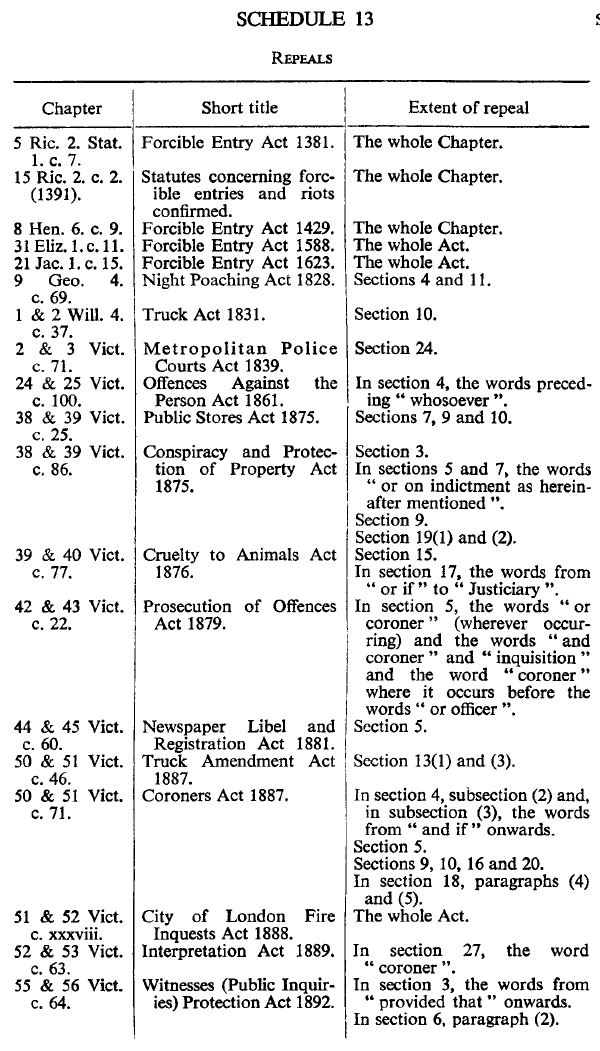
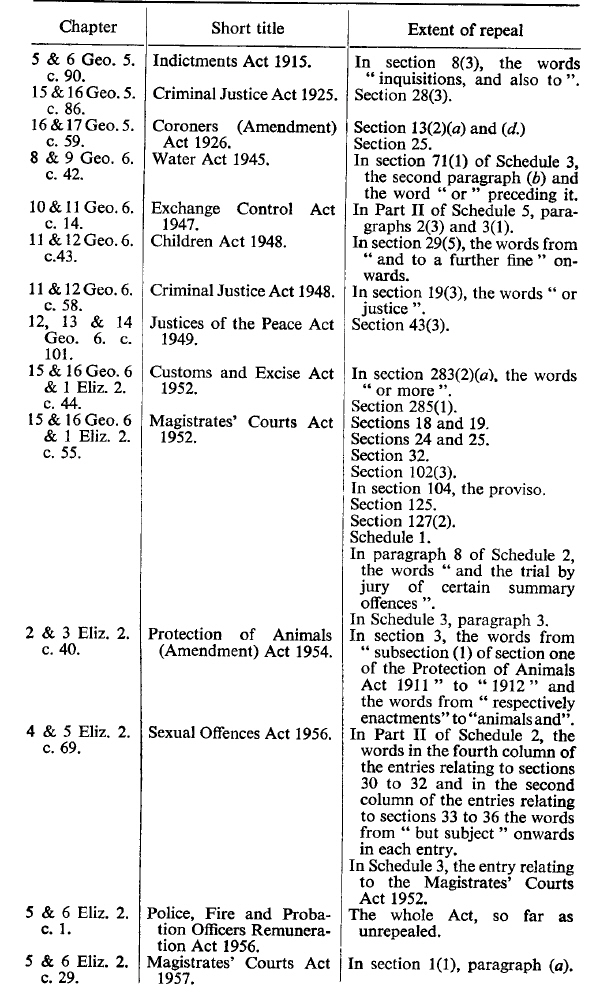
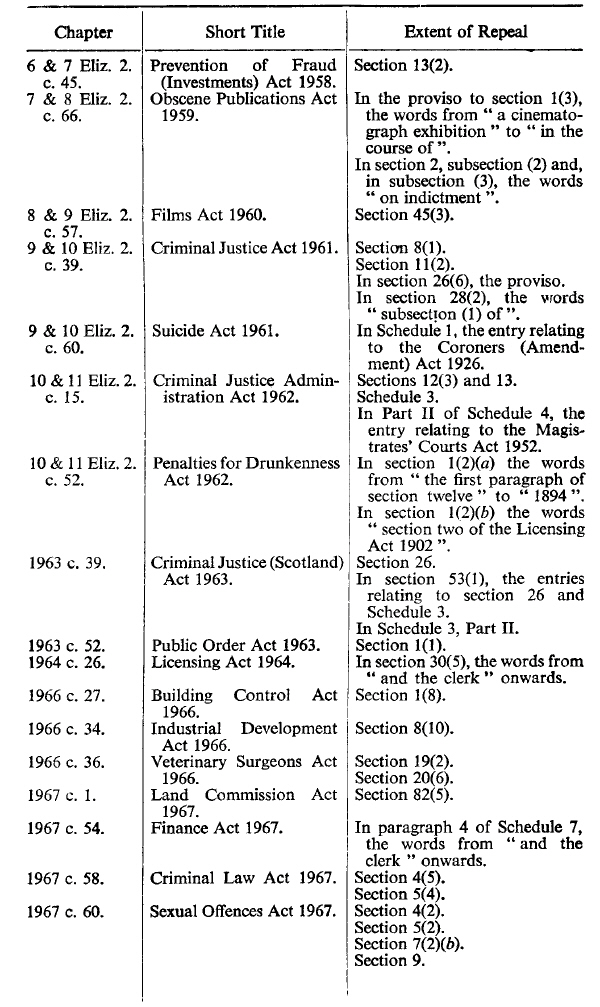
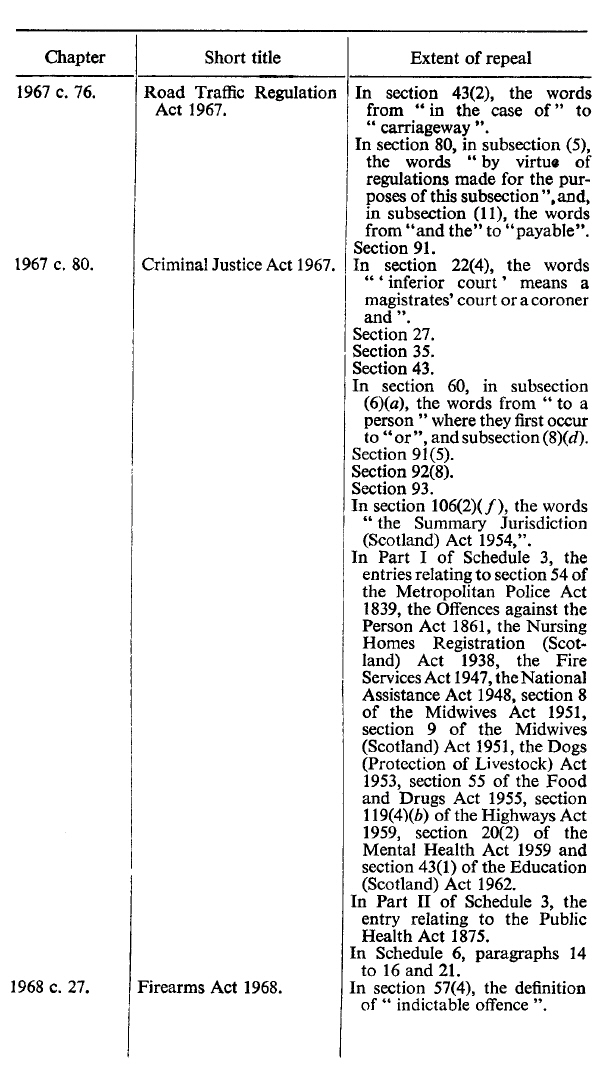
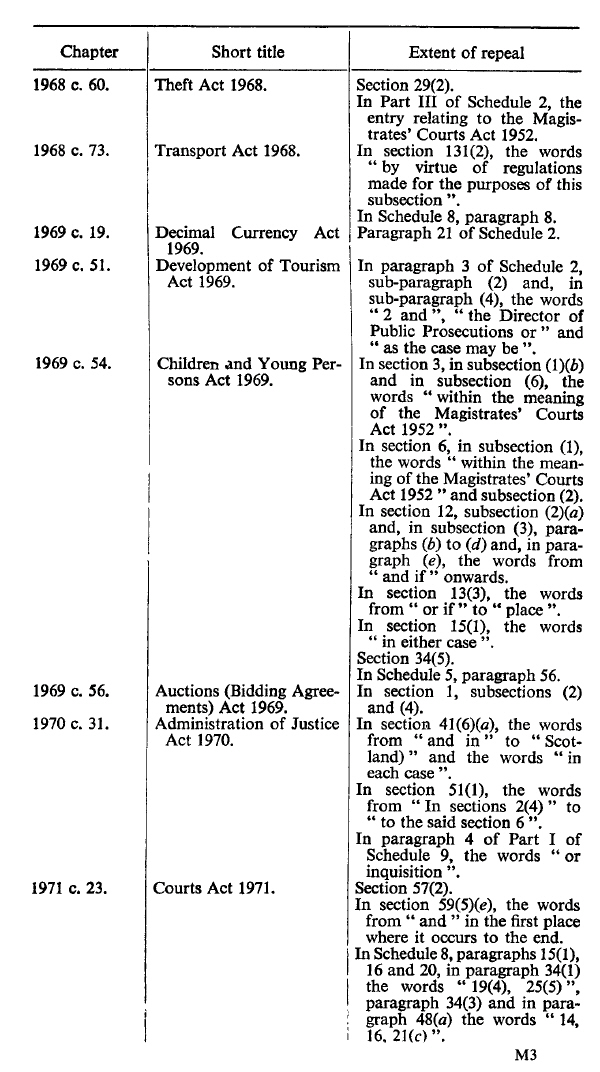
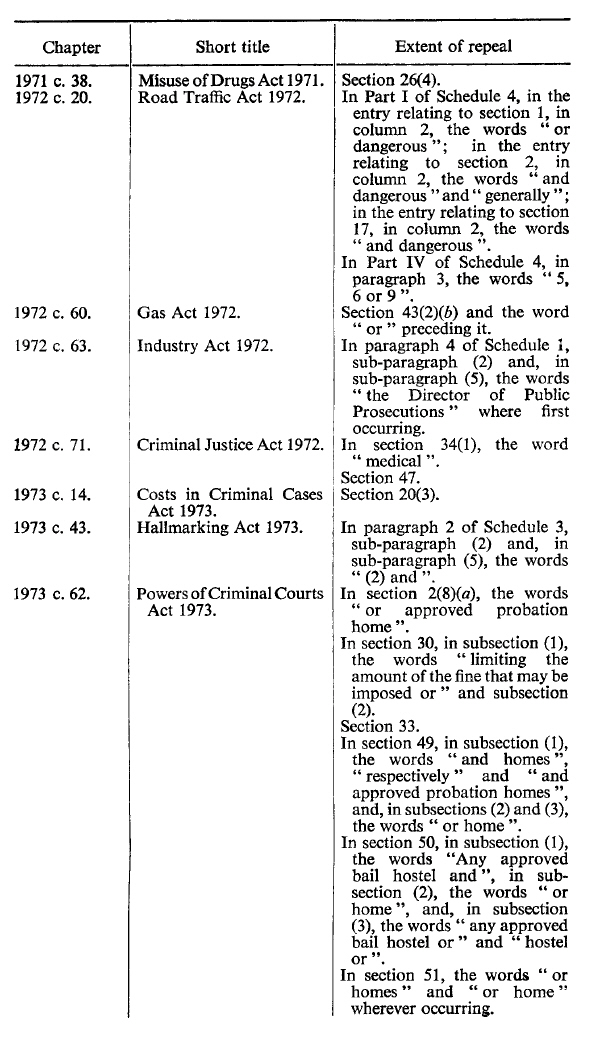
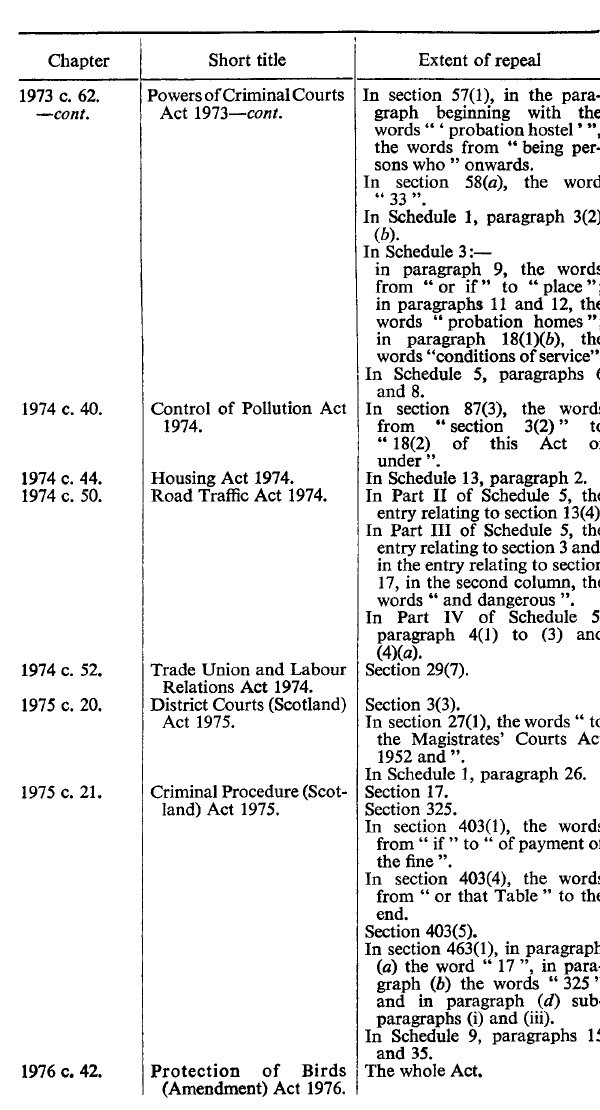
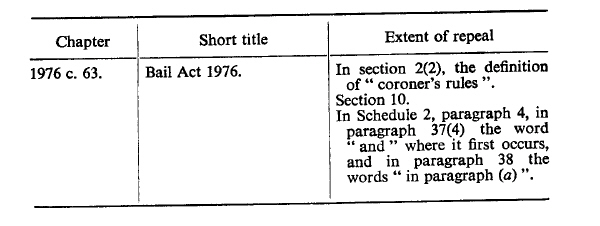
1C1
A provision contained in any of sections F115 and 17 above or in Schedule 11 to this Act, and any related amendment or repeal provided for in Schedule 12 or 13 to this Act, shall not apply in relation to proceedings commenced before the coming into force of that provision.
5
Except as provided in paragraph 3 above a provision of this Act . . . F1 which relates to the punishment by way of fine or imprisonment for any offence shall not affect the punishment for an offence committed before that provision comes into force.