The Mental Capacity Act 2005 (Transitional and Consequential Provisions) Order 2007
S.I. 2007/1898 · Made 22 June 2007
mental capacity, england & wales
Made 22nd June 2007
Laid before Parliament 4th July 2007
Coming into force 1st October 2007
The Lord Chancellor makes the following Order, in exercise of the powers conferred upon him by section 67(3) of the Mental Capacity Act 2005f1.
Annotations to the whole text
Footnotes
- f1
Contents
- 1Citation and commencement
- 2Interpretation
- 3Proceedings begun in the High Court before 1 October 2007
- 4Senior Judge of the Court of Protection
- 5Advance decisions to refuse life-sustaining treatment
- 6Minor and consequential amendments
- Signature
- Schedule 1
- Chapter MINOR AND CONSEQUENTIAL AMENDMENTS
- 1Trustee Savings Bank Life Annuity Regulations 1930
- 2Savings Contract Regulations 1969
- 3Pensions Increase (Judicial Pensions) Regulations 1972
- 4National Savings Bank Regulations 1972
- 5Premium Savings Bond Regulations 1972
- 6National Savings Stock Register Regulations 1976
- 7Motor Vehicles (Tests) Regulations 1981
- 8The Mental Health Review Tribunal Rules 1983
- 9Savings Certificates (Yearly Plan) Regulations 1984
- 10Road Vehicles (Construction and Use) Regulations 1986
- 11Operation of Public Service Vehicles (Partnership) Regulations 1986
- 12Insolvency Rules 1986
- 13Non-contentious Probate Rules 1987
- 14Judicial Pension (Preservation of Benefits) Order 1988
- 15Judicial Pensions (Requisite Benefits) Order 1988
- 16Church of England Pensions Regulations 1988
- 17Savings Certificates Regulations 1991
- 18Savings Certificates (Children’s Bonus Bonds) Regulations 1991
- 19Judicial Pensions (Transfer Between Judicial Pension Schemes) Regulations 1995
- 20Judicial Pensions (Additional Voluntary Contributions) Regulations 1995
- 21Goods Vehicles (Licensing of Operators) Regulations 1995
- 22Landfill Tax Regulations 1996
- 23Family Law Act 1996 (Allocation of Proceedings) Order 1997
- 24General Chiropractic Council (Constitution and Procedure) Rules Order 1999
- 25Health Service Medicines (Price Control Appeals) Regulations 2000
- 26Ionising Radiation (Medical Exposure) Regulations 2000
- 27Carers (Services) and Direct Payments (Amendment) (England) Regulations 2001
- 28Care Homes Regulations 2001
- 29Private and Voluntary Health Care (England) Regulations 2001
- 30Domiciliary Care Agencies Regulations 2002
- 31Land Registration Rules 2003
- 32National Health Service (Travel Expenses and Remission of Charges) Regulations 2003
- 33Child Trust Funds Regulations 2004
- 34National Health Service (Complaints) Regulations 2004
- 35Commonhold Regulations 2004
- 36Adult Placement Schemes (England) Regulations 2004
- 37Damages (Variation of Periodical Payments) Order 2005
- 38Disability Discrimination (Service Providers and Public Authorities Carrying Out Functions) Regulations 2005
- 39Disability Discrimination (Private Clubs etc) Regulations 2005
- 40Disability Discrimination (Premises) Regulations 2006
- Schedule 2 – Amendments to forms in Schedule 4 (Forms) of t
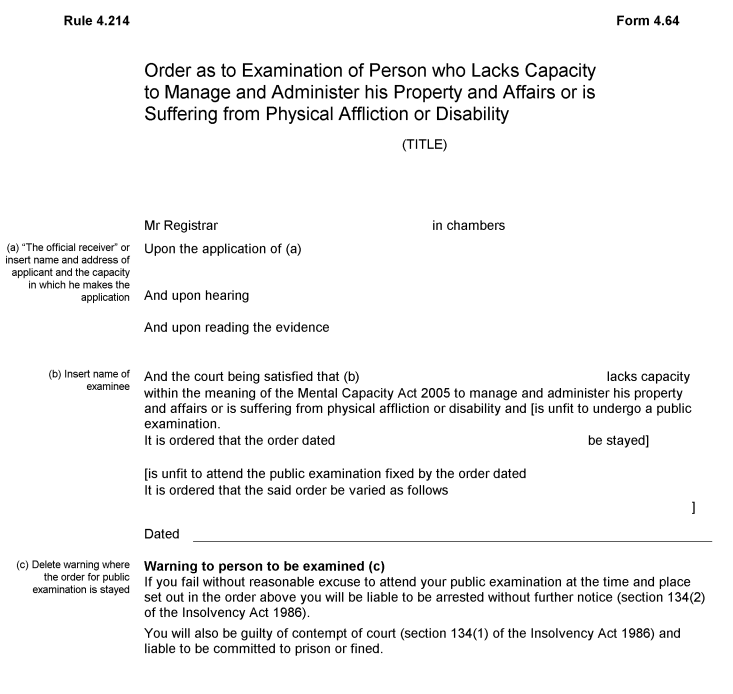
- 1 – new form 4.64Part 1 – new form 4.64
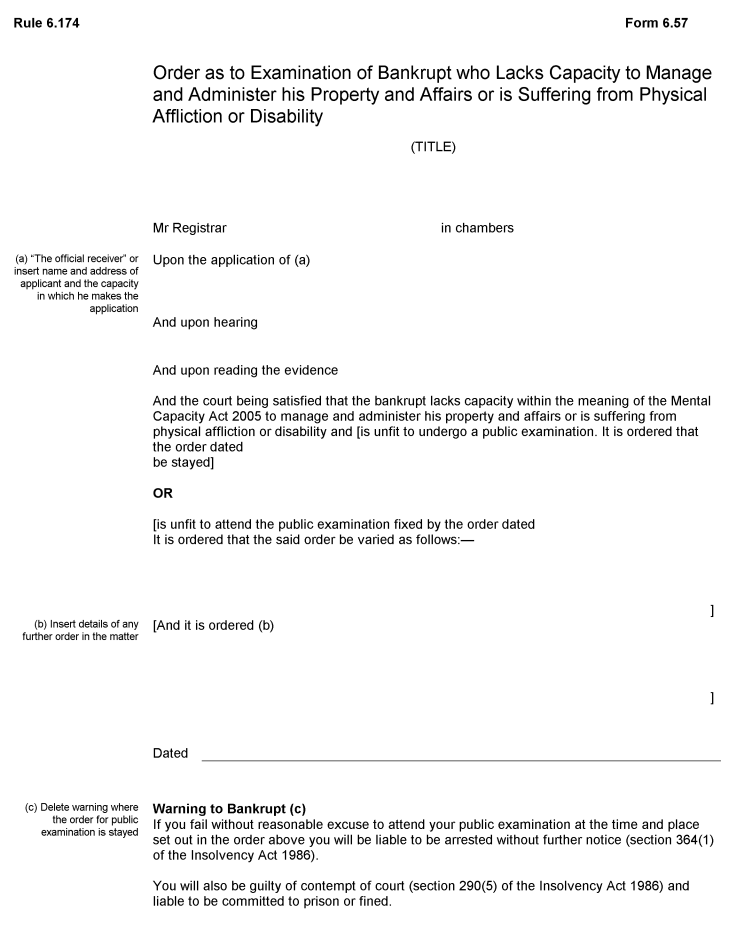
- 2 – new form 6.57Part 2 – new form 6.57
- Explanatory note
1Citation and commencement
This Order may be cited as the Mental Capacity Act 2005 (Transitional and Consequential Provisions) Order 2007, and comes into force on 1 October 2007.
2Interpretation
In this Order—
“the Act” means the Mental Capacity Act 2005; and
“Court of Protection” refers—
the first time the expression appears in article 4, to the office of the Supreme Court called the Court of Protection mentioned in section 45(6) of the Act, and
where the expression appears in articles 3, 4(a) and (b), to the superior court of record established by section 45(1) of the Act.
3Proceedings begun in the High Court before 1 October 2007
This article applies to any proceedings about P’s personal welfare begun in the High Court before 1 October 2007 in respect of which the Court of Protection would, but for this article, have jurisdiction on and after that date under section 16 of the Act.
The proceedings may continue to be dealt with, until they are finally decided, in accordance with the arrangements existing immediately before 1 October 2007.
For the purposes of paragraph (2), an application is finally decided when it is determined and there is no possibility of the determination being reversed or varied on an appeal.
In dealing with proceedings under this article, the High Court retains all the powers and jurisdiction in relation to any matter that is the subject of the proceedings that it had immediately before the commencement of the Act.
In this article—
“P” means any person (other than a protected party) who lacks, or so far as consistent with the context is alleged to lack, capacity to make a decision or decisions in relation to any matter that is the subject of an application to the court and references to a person who lacks capacity are to be construed in accordance with the Act;
“personal welfare” is to be construed in accordance with section 17 of the Act; and
“protected party” means a party, or an intended party (other than P or a child), who lacks capacity to conduct the proceedings.
4Senior Judge of the Court of Protection
The person who, immediately before the commencement of Part 2 of the Act, holds the office of Master of the Court of Protectionf1, shall be treated as—
being a circuit judge nominated under section 46(1) of the Act to exercise the jurisdiction of the Court of Protection; and
having been appointed the Senior Judge of the Court of Protection under section 46(4) of the Act.
5Advance decisions to refuse life-sustaining treatment
An advance decision refusing life-sustaining treatment shall be treated as valid and applicable to a treatment and does not have to satisfy the requirements mentioned in paragraph (3) if the conditions in paragraph (2) are met.
The conditions that must be met are that—
a person providing health care for a person (“P”) reasonably believes that –
P has made the advance decision refusing life-sustaining treatment before 1 October 2007, and
P has lacked the capacity to comply with the provisions mentioned in paragraph (3) since 1 October 2007;
the advance decision is in writing;
P has not—
withdrawn the decision at a time when he had capacity to do so, or
done anything else clearly inconsistent with the advance decision remaining his fixed decision;
P does not have the capacity to give or refuse consent to the treatment in question at the material time;
the treatment in question is the treatment specified in the advance decision;
any circumstances specified in the advance decision are present; and
there are no reasonable grounds for believing that circumstances exist which P did not anticipate at the time of the advance decision and which would have affected his decision had he anticipated them.
The requirements that do not have to be satisfied are as follows—
the requirement for the decision to be verified by a statement by P to the effect that the advance decision is to apply to that treatment even if life is at risk (section 25(5)(a) of the Act); and
the requirement for a signed and witnessed advance decision (section 25(6)(b) to (d) of the Act).
In this article, “advance decision” has the meaning given in section 24(1) of the Act.
6Minor and consequential amendments
Schedule 1 contains minor and consequential amendments.
Signature
Signed by authority of the Lord Chancellor
Catherine Ashton
Parliamentary Under-Secretary of State
Ministry of Justice
22nd June 2007
1Trustee Savings Bank Life Annuity Regulations 1930
In regulation 16(2) of the Trustee Savings Bank Life Annuity Regulations 1930f1—
for the words “a person who is incapable, by reason of mental disorder within the meaning of the Mental Health Act 1959, of managing and administering his property and affairs” substitute “a person who lacks mental capacity within the meaning of the Mental Capacity Act 2005 (c.9) to administer and manage his property and affairs”; and
for the word “receiver” substitute “deputy”.
2Savings Contract Regulations 1969
The Savings Contract Regulations 1969f1 are amended in accordance with this paragraph.
In regulation 2(1) (interpretation), omit the entries for “mentally disordered person” and “receiver” and, in the appropriate alphabetical position, insert—
“ “deputy” in the application of these Regulations to England and Wales, means, in relation to any decision made for a person who lacks capacity, a deputy appointed by the Court of Protection for that person with power to make decisions in relation to the matters in question;”; and
“ “person who lacks capacity” means a person who lacks capacity within the meaning of the Mental Capacity Act 2005 (c.9);”.
In regulation 7 (payment in case of mentally disordered persons)—
in the title, for “mentally disordered persons” substitute “persons who lack capacity”; and
in paragraphs (1) and (2) in each place—
for “mentally disordered person” substitute “person who lacks capacity”, and
for “receiver” substitute “deputy”.
In regulation 12 (persons under disability)—
for “mentally disordered person” substitute “person who lacks capacity”; and
for “receiver” substitute “deputy”.
In regulation 27 (application to Scotland)—
in paragraph (a), for “mentally disordered person” substitute “person who lacks capacity”; and
in paragraph (b), for “receiver in relation to a mentally disordered person” substitute “deputy in relation to a person who lacks capacity”.
In regulation 28(2) (application to Northern Ireland)—
in sub-paragraph (a), for “mentally disordered person” substitute “person who lacks capacity”; and
in sub-paragraph (b), for “receiver in relation to a mentally disordered person” substitute “deputy in relation to a person who lacks capacity”.
In regulation 29(2)(a) (application to the Isle of Man), for “receiver in relation to a mentally disordered person” substitute “deputy in relation to a person who lacks capacity”.
In regulation 30 (application to the Channel Islands)—
in paragraphs (2)(a) and (3)(a), for “mentally disordered person” substitute “person who lacks capacity”; and
in paragraphs (2)(b) and (3)(b), for “receiver in relation to a mentally disordered person” substitute “deputy in relation to a person who lacks capacity”.
3Pensions Increase (Judicial Pensions) Regulations 1972
In paragraph 9 of the Schedule to the Pensions Increase (Judicial Pensions) Regulations 1972f1, omit the reference to a Master of the Court of Protection except in the case of a person holding that office immediately before the commencement of this paragraph or who had previously retired from that office or died.
4National Savings Bank Regulations 1972
The National Savings Bank Regulations 1972f1 are amended in accordance with this paragraph.
In regulation 2(1) (interpretation), omit the entries for “mentally disordered person” and “receiver” and, in the appropriate alphabetical position, insert—
“ “deputy” in the application of these Regulations to England and Wales, means, in relation to any decision made for a person who lacks capacity, a deputy appointed by the Court of Protection for that person with power to make decisions in relation to the matters in question;”; and
“ “person who lacks capacity” means a person who lacks capacity within the meaning of the Mental Capacity Act 2005 (c.9);”.
In regulation 7 (mentally disordered persons)—
in the title, for “Mentally disordered persons” substitute “Persons who lack capacity”;
in paragraph (1), for “mentally disordered person, by his receiver” substitute “person who lacks capacity, by his deputy”;
in paragraphs (2), (3) and (4) in each place—
for “mentally disordered person” substitute “person who lacks capacity”, and
for “receiver” substitute “deputy”;
In regulation 8(4)(c) (joint accounts)—
for “mentally disordered person” substitute “person who lacks capacity”; and
for “receiver” substitute “deputy”.
In regulation 9(4) (trust accounts)—
for both references to “mentally disordered person” substitute “person who lacks capacity”; and
for “receiver” substitute “deputy”.
In regulation 37(1)(b) (payment under nomination)—
for “mentally disordered person” substitute “person who lacks capacity”; and
for “receiver” substitute “deputy”.
In regulation 45 (persons under disability)—
for “mentally disordered person” substitute “person who lacks capacity”; and
for “receiver” substitute “deputy”.
In regulation 57(2)(a) (application to the Isle of Man), for “receiver in relation to a mentally disordered person” substitute “deputy in relation to a person who lacks capacity”.
In regulation 58 (application to the Channel Islands)—
in paragraphs (2)(a) and (3)(a), for “mentally disordered person” substitute “person who lacks capacity”; and
in paragraphs (2)(b) and (3)(b), for “receiver in relation to a mentally disordered person” substitute “deputy in relation to a person who lacks capacity”.
5Premium Savings Bond Regulations 1972
The Premium Savings Bond Regulations 1972f1 are amended in accordance with this paragraph.
In regulation 2(1) (interpretation), omit the entries for “mentally disordered person” and “receiver” and, in the appropriate alphabetical position, insert—
“ “deputy” in the application of these Regulations to England and Wales, means, in relation to any decision made for a person who lacks capacity, a deputy appointed by the Court of Protection for that person with power to make decisions in relation to the matters in question;”; and
“ “person who lacks capacity” means a person who lacks capacity within the meaning of the Mental Capacity Act 2005 (c.9);”.
In regulation 4 (persons entitled to purchase and hold bonds)—
in paragraph (3)(b), for “mentally disordered person, by his receiver” substitute “a person who lacks capacity, by his deputy”; and
in paragraph (5)(b), for “mentally disordered person” substitute “person who lacks capacity”.
In regulation 10 (payment in case of mentally disordered persons)—
in the title, for “Mentally disordered persons” substitute “Persons who lack capacity”;
in paragraph (1) –
for “mentally disordered person” substitute “person who lacks capacity”, and
for “receiver” substitute “deputy”; and
in paragraph (2), for “mentally disordered person for whose estate no receiver” substitute “person who lacks capacity for whom no deputy has been appointed in relation to his property and affairs”.
In regulation 16 (persons under disability)—
for “mentally disordered person” substitute “person who lacks capacity”; and
for “receiver” substitute “deputy”.
In regulation 31 (application to Scotland)—
in paragraph (a), for “mentally disordered person” substitute “person who lacks capacity”; and
in paragraph (b), for “receiver in relation to a mentally disordered person” substitute “deputy in relation to a person who lacks capacity”.
In regulation 32(2) (application to Northern Ireland)—
in paragraph (a), for “mentally disordered person” substitute “person who lacks capacity”; and
in paragraph (b), for “receiver in relation to a mentally disordered person” substitute “deputy in relation to a person who lacks capacity”.
In regulation 33(2)(a) (application to the Isle of Man), for “receiver in relation to a mentally disordered person” substitute “deputy in relation to a person who lacks capacity”.
In regulation 34 (application to the Channel Islands)—
in paragraphs (2)(a) and (3)(a), for “mentally disordered person” substitute “person who lacks capacity”; and
in paragraphs (2)(b) and (3)(b), for “receiver in relation to a mentally disordered person” substitute “deputy in relation to a person who lacks capacity”.
6National Savings Stock Register Regulations 1976
The National Savings Stock Register Regulations 1976f1 are amended in accordance with this paragraph.
In regulation 2(1) (interpretation), omit the entries for “mentally disordered person” and “receiver” and, in the appropriate alphabetical position, insert—
“ “deputy” in the application of these Regulations to England and Wales, means, in relation to any decision made for a person who lacks capacity, a deputy appointed by the Court of Protection for that person with power to make decisions in relation to the matters in question;”; and
“ “person who lacks capacity” means a person who lacks capacity within the meaning of the Mental Capacity Act 2005 (c.9);”.
In regulation 31 (persons under disability)—
in paragraphs (1) and (2) in each place—
for “mentally disordered person” substitute “person who lacks capacity”; and
for “receiver” substitute “deputy”; and
in paragraphs (3) and (4), for “mentally disordered person” substitute “person who lacks capacity”.
In regulation 59 (application to Scotland)—
in paragraph (a), for “mentally disordered person” substitute “person who lacks capacity”; and
in paragraph (b), for “receiver in relation to a mentally disordered person” substitute “deputy in relation to a person who lacks capacity”.
In regulation 60(2) (application to Northern Ireland)—
in paragraph (a), for “mentally disordered person” substitute “person who lacks capacity”; and
in paragraph (b), for “receiver in relation to a mentally disordered person” substitute “deputy in relation to a person who lacks capacity”.
In regulation 61(2)(a) (application to the Isle of Man), for “receiver in relation to a mentally disordered person” substitute “deputy in relation to a person who lacks capacity”.
In regulation 62 (application to the Channel Islands)—
in paragraphs (2)(a) and (3)(a), for “mentally disordered person” substitute “person who lacks capacity”; and
in paragraphs (2)(b) and (3)(b), for “receiver in relation to a mentally disordered person” substitute “deputy in relation to a person who lacks capacity”.
7Motor Vehicles (Tests) Regulations 1981
In regulation 9(1)(c) (cessations: general) of the Motor Vehicles (Tests) Regulations 1981f1, for the words from “patient” to “Mental Health Act 1983” substitute “person who lacks capacity (within the meaning of the Mental Capacity Act 2005 (c.9)) to carry on the activities covered by the authorisation”.
8The Mental Health Review Tribunal Rules 1983
For rule 7(c) (notice to other persons interested) of the Mental Health Review Tribunal Rules 1983f1, substitute—
“(c)where there is an extant order of either—
(i)the office of the Supreme Court called the Court of Protection mentioned in section 45(6) of the Mental Capacity Act 2005 (c.9), or
(ii)the superior court of record established by section 45(1) of the Mental Capacity Act 2005,
to the court referred to in sub-paragraph (ii) of this rule;”
9Savings Certificates (Yearly Plan) Regulations 1984
The Savings Certificates (Yearly Plan) Regulations 1984f1 are amended in accordance with this paragraph.
In regulation 2 (interpretation), omit the entries for “mentally disordered person” and “receiver” and, in the appropriate alphabetical position, insert—
“ “deputy” in the application of these Regulations to England and Wales, means, in relation to any decision made for a person who lacks capacity, a deputy appointed by the Court of Protection for that person with power to make decisions in relation to the matters in question;”; and
“ “person who lacks capacity” means a person who lacks capacity within the meaning of the Mental Capacity Act 2005 (c.9);”.
In regulation 4(2)(b) (persons entitled to enter into agreements and to hold certificates), for “mentally disordered person, by his receiver” substitute “person who lacks capacity, by his deputy”.
In regulation 5(2) (maximum payments), for “mentally disordered person” substitute “person who lacks capacity”.
In regulation 8 (repayment in case of persons under 7 years of age and mentally disordered persons)—
in the title, for “mentally disordered persons” substitute “persons who lack capacity”;
in paragraph (2), for “mentally disordered person shall be made, by his receiver” substitute “person who lacks capacity shall be made, by his deputy”; and
in paragraph (3), for “mentally disordered person for whose estate no receiver” substitute “person who lacks capacity for whom no deputy”.
In regulation 9(1)(a) (repayment in case of joint trustees)—
for “mentally disordered person” substitute “person who lacks capacity”; and
for “receiver” substitute “deputy”.
In regulation 10(1)(a) (repayment in case of certificate held by person jointly)—
for “mentally disordered person” substitute “person who lacks capacity”; and
for “receiver” substitute “deputy”.
In regulation 18 (persons under disability)—
for “mentally disordered person” substitute “person who lacks capacity”; and
for “receiver” substitute “deputy”.
In regulation 33 (application to Scotland)—
in paragraph (a), for “mentally disordered person” substitute “person who lacks capacity”; and
in paragraph (b), for “receiver in relation to a mentally disordered person” substitute “deputy in relation to a person who lacks capacity”.
In regulation 34(2) (application to Northern Ireland)—
in paragraph (a), for “mentally disordered person” substitute “person who lacks capacity”; and
in paragraph (b), for “receiver in relation to a mentally disordered person” substitute “deputy in relation to a person who lacks capacity”.
In regulation 35(2)(a) (application to the Isle of Man), for “receiver in relation to a mentally disordered person” substitute “deputy in relation to a person who lacks capacity”.
In regulation 36 (application to the Channel Islands)—
in paragraphs (2)(a) and (3)(a), for “mentally disordered person” substitute “person who lacks capacity”; and
in paragraphs (2)(b) and (3)(b), for “receiver in relation to a mentally disordered person” substitute “deputy in relation to a person who lacks capacity”.
10Road Vehicles (Construction and Use) Regulations 1986
In paragraph 5(1)(c) of Part 1 of Schedule 3B (authorised sealers) to the Road Vehicles (Construction and Use) Regulations 1986f1, for the words from “patient” to “Mental Health Act 1983”, substitute “person who lacks capacity (within the meaning of the Mental Capacity Act 2005 (c.9)) to carry on the activities covered by the authorisation”.
11Operation of Public Service Vehicles (Partnership) Regulations 1986
On the entry as to section 57(2) of the Public Passenger Vehicles Act 1981f1, in column 2 of Part 1 of the Schedule to the Operation of Public Service Vehicles (Partnership) Regulations 1986f2, for the words from “patient” to “Mental Health Act 1983”, substitute “person who lacks capacity (within the meaning of the Mental Capacity Act 2005 (c.9)) to carry on the activities covered by the licence”.
12Insolvency Rules 1986
The Insolvency Rules 1986f1 are amended in accordance with this paragraph.
In rule 4.214 (witness unfit for examination)—
in paragraph (1)—
omit the words “mental disorder or”, and
before “is suffering” insert “is a person who lacks capacity within the meaning of the Mental Capacity Act 2005 (c.9) or”, and
in paragraph (3)(a), for the words “patient within the meaning of the Mental Health Act 1983” substitute “person who lacks capacity within the meaning of the Mental Capacity Act 2005”.
In rule 6.174 (bankrupt unfit for examination)—
in paragraph (1) –
omit the words “mental disorder or”, and
before “is suffering” insert “is a person who lacks capacity within the meaning of the Mental Capacity Act 2005 or”, and
in paragraph (3)(a), for the words “patient within the meaning of the Mental Health Act 1983”, substitute “person who lacks capacity within the meaning of the Mental Capacity Act 2005”.
In the heading to Part 7 of Chapter 7, for “Persons Incapable of Managing their Affairs”, substitute “Persons who Lack Capacity to Manage their Affairs”.
In rule 7.43 (introductory)—
in paragraph (1), for “is incapable of managing and administering his property and affairs”, substitute “lacks capacity within the meaning of the Mental Capacity Act 2005 to manage and administer his property and affairs”; and
in paragraph (1)(a), for “mental disorder within the meaning of the Mental Health Act 1983”, substitute “lacking capacity within the meaning of the Mental Capacity Act 2005”.
In paragraph 4.64 of Part 4 of Schedule 4, Forms Index (companies winding up)—
after the words “person who”, insert “lacks capacity to manage and administer his property and affairs or”; and
for the words “mental disorder or”, substitute “a”.
In paragraph 6.57 of Part 6 of Schedule 4, Forms Index (bankruptcy)—
after the words “bankrupt who”, insert “lacks capacity to manage and administer his property and affairs or”; and
for the words “mental disorder or”, substitute “a”.
For form 4.64 in Schedule 4 (forms), substitute the form in Schedule 2 (Part 1).
For form 6.57 in Schedule 4 (forms), substitute the form in Schedule 2 (Part 2).
13Non-contentious Probate Rules 1987
Rule 31 (grant to attorneys) and 35 (grants in case of mental incapacity) of the Non-contentious Probate Rules 1987f1 are amended in accordance with this paragraph.
For rule 31(3) substitute—
“(3)Where the donor referred to in paragraph (1) above lacks capacity within the meaning of the Mental Capacity Act 2005 (c.9) and the attorney is acting under an enduring power of attorney or lasting power of attorney, the application shall be made in accordance with rule 35.”
For rule 35, in the title, for the words “mental incapacity” substitute “lack of mental capacity”.
In rule 35(1), for the words “incapable person” substitute “person who lacks capacity within the meaning of the Mental Capacity Act 2005”.
In rule 35(2)—
for the words “is by reason of mental incapacity incapable of managing”, substitute “lacks capacity within the meaning of the Mental Capacity Act 2005 to manage”;
for each reference to an incapable person substitute a reference to a person who lacks capacity within the meaning of the Mental Capacity Act 2005; and
at the end of sub-paragraph (b), insert “or lasting power of attorney”.
In rule 35(4), for the words “incapable person”, substitute “person who lacks capacity within the meaning of the Mental Capacity Act 2005”.
14Judicial Pension (Preservation of Benefits) Order 1988
In Schedule 2 to the Judicial Pension (Preservation of Benefits) Order 1988f1, omit the reference to a Master of the Court of Protection except in the case of a person holding that office immediately before the commencement of this paragraph or who had previously retired from that office or died.
15Judicial Pensions (Requisite Benefits) Order 1988
In Schedule 2 (office) to the Judicial Pensions (Requisite Benefits) Order 1988f1, omit the reference to a Master of the Court of Protection except in the case of a person holding that office immediately before the commencement of this paragraph or who had previously retired from that office or died.
16Church of England Pensions Regulations 1988
Regulation 30 (payment of pensions in respect of persons suffering from mental disorder) of the Church of England Pensions Regulations 1988f1 is amended in accordance with this paragraph.
In paragraph (1)—
for the words “is incapable by reason of mental disorder within the meaning of the Mental Health Act, 1983, of managing and administering”, substitute “lacks capacity (within the meaning of the Mental Capacity Act 2005 (c.9)) to manage and administer”; and
in sub-paragraph (a), for the words “suffering from mental disorder”, substitute “a person lacking capacity (within the meaning of the Mental Capacity Act 2005) to manage and administer his property and affairs”.
In paragraph (2)—
for the words “authority having jurisdiction under Part VII of the Mental Health Act, 1983”, substitute “Court of Protection”; and
for each reference to “that authority” substitute a reference to “the Court of Protection”.
In paragraph (3)—
for the words “the authority having jurisdiction under Part VII of the Mental Health Act, 1983 give”, substitute “the Court of Protection gives”; and
for the words “that authority”, substitute “the Court of Protection”.
17Savings Certificates Regulations 1991
The Savings Certificates Regulations 1991f1 are amended in accordance with this paragraph.
In regulation 2(1) (interpretation), omit the entries for “mentally disordered person” and “receiver” and, in the appropriate alphabetical position, insert—
“ “deputy” in the application of these Regulations to England and Wales, means, in relation to any decision made for a person who lacks capacity, a deputy appointed by the Court of Protection for that person with power to make decisions in relation to the matters in question;”; and
“ “person who lacks capacity” means a person who lacks capacity within the meaning of the Mental Capacity Act 2005 (c.9);”.
In regulation 4(2)(c) (persons entitled to purchase and hold certificates), for “mentally disordered person, by his receiver” substitute “person who lacks capacity, by his deputy”.
In regulation 9 (repayment in case of persons under 7 years of age and mentally disordered persons)—
in the title, for “mentally disordered persons” substitute “persons who lack capacity”;
in paragraph (2), for “mentally disordered person shall be made by his receiver” substitute “person who lacks capacity shall be made by his deputy”; and
in paragraph (4), for the words from “mentally disordered person for” to “of the mentally disordered person” substitute “person who lacks capacity in respect of whom no deputy has been appointed, the Director of Savings may, if he thinks fit, pay the whole or any part of the amount repayable in respect of the certificate to any person who satisfies him that he will apply the payment for the maintenance or otherwise for the benefit of the person who lacks capacity”.
In regulation 10(1)(a) (repayment in case of certificate held by persons jointly)—
for “mentally disordered person” substitute “person who lacks capacity”; and
for “receiver” substitute “deputy”.
In regulation 18 (persons under disability)—
for “mentally disordered person” substitute “person who lacks capacity”; and
for “receiver” substitute “deputy”.
In regulation 33 (application to Scotland)—
in paragraph (a), for “mentally disordered person” substitute “person who lacks capacity”; and
in paragraph (b), for “receiver in relation to a mentally disordered person” substitute “deputy in relation to a person who lacks capacity”.
In regulation 34 (application to Northern Ireland)—
in paragraph (b), for “mentally disordered person” substitute “person who lacks capacity”; and
in paragraph (c), for “receiver in relation to a mentally disordered person” substitute “deputy in relation to a person who lacks capacity”.
In regulation 35(2) (application to the Isle of Man)—
in paragraph (a), for “mentally disordered person” substitute “person who lacks capacity”; and
in paragraph (b), for “receiver in relation to any act or thing done in respect of a mentally disordered person shall be construed as a reference to a receiver” substitute “deputy in relation to any decision made for a person who lacks capacity shall be construed as a reference to a deputy”.
In regulation 36 (application to the Channel Islands)—
in paragraphs (2)(a) and (3)(a), for “mentally disordered person” substitute “person who lacks capacity”; and
in paragraphs (2)(b) and (3)(b), for “receiver in relation to a mentally disordered person” substitute “deputy in relation to a person who lacks capacity”.
In paragraph 2 of Part 1 of Schedule 1 (persons entitled to hold index-linked certificates to be purchased before 7th September 1981), for “receiver on behalf of and in the name of a mentally disordered person” substitute “deputy on behalf of and in the name of a person who lacks capacity”.
18Savings Certificates (Children’s Bonus Bonds) Regulations 1991
The Savings Certificates (Children’s Bonus Bonds) Regulations 1991f1 are amended in accordance with this paragraph.
In regulation 2(1) (interpretation), omit the entries for “mentally disordered person” and “receiver” and, in the appropriate alphabetical position, insert—
“ “deputy” in the application of these Regulations to England and Wales, means, in relation to any decision made for a person who lacks capacity, a deputy appointed by the Court of Protection for that person with power to make decisions in relation to the matters in question;”; and
“ “person who lacks capacity” means a person who lacks capacity within the meaning of the Mental Capacity Act 2005 (c.9);”.
In regulation 8(2) (repayment in case of persons under 16 years of age), for “mentally disordered person” substitute “person who lacks capacity”.
In regulation 9 (repayment in case of mentally disordered persons)—
in the title, for “mentally disordered persons” substitute “persons who lack capacity”;
in paragraph (1), for “mentally disordered person shall be made by his receiver” substitute “person who lacks capacity shall be made by his deputy”; and
in paragraph (2), for “mentally disordered person for whose estate no receiver” substitute “person who lacks capacity for whom no deputy”.
In regulation 15 (persons under disability)—
for “mentally disordered person” substitute “person who lacks capacity”; and
for “receiver” substitute “deputy”.
In regulation 29 (application to Scotland)—
in paragraph (a), for “mentally disordered person” substitute “person who lacks capacity”; and
in paragraph (b), for “receiver in relation to a mentally disordered person” substitute “deputy in relation to a person who lacks capacity”.
In regulation 30 (application to Northern Ireland)—
in paragraph (a), for “mentally disordered person” substitute “person who lacks capacity”; and
in paragraph (b), for “receiver in relation to a mentally disordered person” substitute “deputy in relation to a person who lacks capacity”.
In regulation 31(2) (application to the Isle of Man)—
in paragraph (a), for “mentally disordered person” substitute “person who lacks capacity”; and
in paragraph (b), for “receiver in relation to any act or thing done in respect of a mentally disordered person shall be construed as a reference to a receiver” substitute “deputy in relation to any decision made for a person who lacks capacity shall be construed as a reference to a deputy”.
In regulation 32 (application to the Channel Islands)—
in paragraphs (2)(a) and (3)(a), for “mentally disordered person” substitute “person who lacks capacity”; and
in paragraphs (2)(b) and (3)(b), for “receiver in relation to a mentally disordered person” substitute “deputy in relation to a person who lacks capacity”.
19Judicial Pensions (Transfer Between Judicial Pension Schemes) Regulations 1995
In Schedule 2 (existing judicial scheme judicial offices included in each arrangement) to the Judicial Pensions (Transfer Between Judicial Pension Schemes) Regulations 1995f1, under the cross-heading “District Judiciary Scheme”, omit the reference to a Master of the Court of Protection except in the case of a person holding that office immediately before the commencement of this paragraph or who had previously retired from that office or died.
20Judicial Pensions (Additional Voluntary Contributions) Regulations 1995
In Schedule 4 (existing judicial scheme judicial offices included in each arrangement) to the Judicial Pensions (Additional Voluntary Contributions) Regulations 1995f1, under the cross-heading “District Judiciary Scheme”, omit the reference to a Master of the Court of Protection except in the case of a person holding that office immediately before the commencement of this paragraph or who had previously retired from that office or died.
21Goods Vehicles (Licensing of Operators) Regulations 1995
Regulations 29 (partnerships) and 31 (continuance of licence on death, bankruptcy etc) of the Goods Vehicles (Licensing of Operators) Regulations 1995f1 are amended in accordance with this paragraph.
In regulation 29(11)(b), for the words from “patient” to “Mental Health Act 1983”, substitute “person who lacks capacity (within the meaning of the Mental Capacity Act 2005 (c.9)) to carry on the activities covered by the licence”.
In regulation 31—
in paragraph (2), for the words from “patient” to “Mental Health Act 1983”, substitute “person who lacks capacity (within the meaning of the Mental Capacity Act 2005) to carry on the activities covered by the licence”; and
in paragraph (3), for “patient” substitute “person who lacks capacity (within the meaning of the Mental Capacity Act 2005) to carry on the activities covered by the licence”.
22Landfill Tax Regulations 1996
For regulation 33(1C)(a) (bodies eligible for approval) of the Landfill Tax Regulations 1996f1, substitute—
“(a)in England and Wales, the person lacks capacity within the meaning of the Mental Capacity Act 2005 (c.9) to administer and manage his property and affairs;”.
23Family Law Act 1996 (Allocation of Proceedings) Order 1997
In article 8(2)(b) (transfer from family proceedings court to county court) of the Family Law Act 1996 (Allocation of Proceedings) Order 1997f1, for the words “a person who, by reason of mental disorder within the meaning of the Mental Health Act 1983, is incapable of managing and administering his property and affairs” substitute “a person lacking capacity within the meaning of the Mental Capacity Act 2005 (c.9) to conduct the proceedings”.
24General Chiropractic Council (Constitution and Procedure) Rules Order 1999
In rule 2 (grounds of removal) of the General Chiropractic Council (Constitution and Procedure) Rules Order of Council 1999f1, in paragraph (1)(d) for “or is otherwise incapable, by reason of mental disorder, of properly managing his property or affairs”, substitute “or lacks capacity within the meaning of the Mental Capacity Act 2005 (c.9), to properly manage his property or affairs”.
25Health Service Medicines (Price Control Appeals) Regulations 2000
In regulation 7 (appointment of tribunal) of the Health Service Medicines (Price Control Appeals) Regulations 2000f1, in paragraph (3)(b), for “incapacity” substitute “lack of capacity (within the meaning of the Mental Capacity Act 2005 (c.9))”.
26Ionising Radiation (Medical Exposure) Regulations 2000
In regulation 7 (optimisation) of the Ionising Radiation (Medical Exposure) Regulations 2000f1—
in paragraph (5)(b), after “capacity” insert “(within the meaning of the Mental Capacity Act 2005 (c.9) in the case of a child aged sixteen or seventeen)”; and
in paragraph (5)(c), after “capacity” insert “(within the meaning of the Mental Capacity Act 2005)”.
27Carers (Services) and Direct Payments (Amendment) (England) Regulations 2001
For regulation 2(2) (services of an intimate nature and prescribed circumstances) of the Carers (Services) and Direct Payments (Amendment) (England) Regulations 2001f1, substitute—
“(2)Where a service (A) is being delivered to the person cared for, a service of an intimate nature may be provided if—
(a)during the delivery of service A, the person cared for asks the person delivering that service to provide a service of an intimate nature;
(b)the person lacks capacity (within the meaning of the Mental Capacity Act 2005 (c.9)) to consent to the provision of a service of an intimate nature and it is provided in accordance with the principles of that Act; or
(c)except where sub-paragraph (b) applies, the person cared for is in a situation in which he is likely to suffer serious personal harm unless a service of an intimate nature is provided to him and the person providing service A reasonably believes that it is necessary to provide a service of an intimate nature because the likelihood of serious personal harm to the person cared for is imminent.”.
28Care Homes Regulations 2001
The Care Homes Regulations 2001f1 are amended in accordance with this paragraph.
In regulation 2 (interpretation), in paragraph (1), in the appropriate alphabetical position, insert—
“ “the 2005 Act” means the Mental Capacity Act 2005 (c.9);” and
“ “lacks capacity” means lacks capacity within the meaning of the 2005 Act;”.
In regulation 13 (further requirements as to health and welfare), for paragraph (7) substitute—
“(7)The registered person shall ensure that no service user is subject to physical restraint unless—
(a)restraint of the kind employed is the only practicable means of securing the welfare of that or any other service user and there are exceptional circumstances; or
(b)in the case of a person who lacks capacity in relation to the matter in question, the act meets the conditions of section 6 of the 2005 Act.”.
29Private and Voluntary Health Care (England) Regulations 2001
The Private and Voluntary Health Care (England) Regulations 2001f1 are amended in accordance with this paragraph.
In regulation 2 (interpretation)—
in paragraph (1), at the beginning insert—
““the 2005 Act” means the Mental Capacity Act 2005 (c.9);”; and
at the end, add—
“(4)For the purpose of any decision required to be made under these Regulations as to a person’s capacity, lack of capacity shall be interpreted in accordance with the 2005 Act and any reference to a person who lacks capacity shall be construed accordingly.”.
In regulation 9 (policies and procedures), in paragraph (3)—
in sub-paragraph (a), for “competence” substitute “capacity”;
in sub-paragraph (b), for “competent patient” substitute “patient who has capacity”; and
for sub-paragraph (c), substitute—
“(c)in the case of patient who lacks capacity the requirements of the 2005 Act are complied with before any treatment proposed for him is administered; and”.
In regulation 16 (care and welfare of patients), in paragraphs (1) and (3), after “so far as practicable,” insert “(and, where the person lacks capacity, in accordance with the principles of the 2005 Act)”.
In regulation 35 (resuscitation), in paragraph (2)—
in sub-paragraph (a), for “are competent” substitute “have the capacity”; and
after sub-paragraph (a), insert—
“(aa)take proper account of valid and applicable advance decisions made by patients under the 2005 Act;”.
In regulation 37 (surgical procedures)—
in paragraph (2), after “a patient” insert “who has the capacity to do so”;
in paragraph (3), for “is not competent” substitute “lacks the capacity”; and
after paragraph (3), insert—
“(4)In the case of a patient who lacks capacity to consent to surgery, the registered person shall take proper account of any valid and applicable advance decisions made by the patient under the 2005 Act.”.
30Domiciliary Care Agencies Regulations 2002
The Domiciliary Care Agencies Regulations 2002f1 are amended in accordance with this paragraph.
In regulation 2 (interpretation), in paragraph (1), in the appropriate alphabetical position, insert—
““the 2005 Act” means the Mental Capacity Act 2005 (c.9);
“lacks capacity” means lacks capacity within the meaning of the 2005 Act;”.
In regulation 14 (arrangements for the provision of personal care), for paragraph (10) substitute—
“(10)The registered person shall ensure that no service user is subject to physical restraint unless—
(a)restraint of the kind employed is the only practicable means of securing the welfare of that or any other service user and there are exceptional circumstances; or
(b)in the case of a person who lacks capacity in relation to the matter in question, the act meets the conditions of section 6 of the 2005 Act.”.
31Land Registration Rules 2003
Rule 61 (documents executed by attorney) of, and Schedule 3 (forms referred to in rule 206) to, the Land Registration Rules 2003f1 are amended in accordance with this paragraph.
In rule 61—
for paragraph (1)(c) substitute—
“(c)a document which under section 4 of the Evidence and Powers of Attorney Act 1940, paragraph 16 of Part 2 of Schedule 1, or paragraph 15(3) of Part 5 of Schedule 4 to the Mental Capacity Act 2005 (c.9) is sufficient evidence of the contents of the power, or”; and
for paragraph (2) substitute—
“(2)If an order or direction under section 22 or 23 of, or paragraph 16 of Part 5 of Schedule 4 to, the Mental Capacity Act 2005 has been made with respect to a power or the donor of the power or the attorney appointed under it, the order or direction must be produced to the registrar.”.
In Schedule 3—
in Form 1 (certificate as to execution of power of attorney (rule 61))—
for the first bullet point substitute—
“the power of attorney (“the power”) is in existence [and is made and, where required, has been registered under (state statutory provisions under which the power is made and, where required, has been registered, if applicable)],”, and
in the fourth bullet point, for the words “or section 7(3) of the Enduring Powers of Attorney Act 1985”, substitute—
“, paragraph 16 of Part 2 of Schedule 1, or paragraph 15(3) of Part 5 of Schedule 4 to the Mental Capacity Act 2005”; and
in Form 2 (statutory declaration/certificate as to non-revocation for powers more than 12 months old at the date of the disposition for which they are used (rule 62) –
in the third bullet point, for the words “valid enduring power”, substitute “valid lasting or enduring power of attorney”,
after the third bullet point, insert—
“Where the power is in the form prescribed for a lasting power of attorney—
that a lasting power of attorney was not created, or
of circumstances which, if the lasting power of attorney had been created, would have terminated the attorney’s authority to act as an attorney, or”, and
in the heading immediately before the fourth bullet point, after the words “enduring power”, insert “of attorney”.
32National Health Service (Travel Expenses and Remission of Charges) Regulations 2003
In regulation 7 (claims to entitlement) of the National Health Service (Travel Expenses and Remission of Charges) Regulations 2003f1, for paragraph (3), substitute—
“(3)A claim may be made on behalf of another person where that person—
(a)is unable by reason of physical incapacity; or
(b)lacks capacity within the meaning of the Mental Capacity Act 2005 (c.9),
to make the claim himself.”.
33Child Trust Funds Regulations 2004
In regulation 33A(2) (the official solicitor or accountant of court to be the person who has the authority to manage an account) of the Child Trust Funds Regulations 2004f1, in Condition 4—
in sub-paragraph (a), for the word “receiver” substitute “deputy”;
for sub-paragraph (b), substitute “(b) determined that such a person lacks capacity within the meaning of the Mental Capacity Act 2005 (c.9) to manage the child’s property and affairs”; and
in the modifications of condition 4 for Scotland—
in sub-paragraph (b), for the word “receiver” substitute “deputy”; and
in sub-paragraph (c), for the word “patient” substitute “person lacking capacity”.
34National Health Service (Complaints) Regulations 2004
In regulation 8 (person who may make complaints) of the National Health Service (Complaints) Regulations 2004f1—
in paragraph (2)(c), omit “or mental” and “or”;
after paragraph(2)(c), insert—
“(cc)is unable because he lacks capacity within the meaning of the Mental Capacity Act 2005 (c.9) to make the complaint himself; or”;
in paragraph (3), after “who is” insert “physically”; and
after paragraph (3) insert—
“(3A)In the case of a patient or person affected who lacks capacity within the meaning of the Mental Capacity Act 2005 the representative must be either a person appointed or authorised to act on his behalf under the 2005 Act or another person who, in the opinion of the complaints manager, had or has a sufficient interest in his welfare and is a suitable person to act as representative”.
35Commonhold Regulations 2004
In the table of contents in Schedule 2 (articles of association) to the Commonhold Regulations 2004f1, under the heading “Votes of Members”, for the words “Entitlement to vote – Mental Incapacity” substitute “Entitlement to vote – lack of mental capacity”.
In the title to article 29 of Schedule 2 (articles of association) to the Commonhold Regulations 2004, for the words “mental incapacity” substitute “lack of mental capacity”.
In article 29 of Schedule 2 (articles of association) to the Commonhold Regulations 2004, for each reference to “receiver” substitute a reference to “deputy”.
36Adult Placement Schemes (England) Regulations 2004
The Adult Placement Schemes (England) Regulations 2004f1 are amended in accordance with this paragraph.
In regulation 2 (interpretation), in the appropriate alphabetical position, insert—
“ “the 2005 Act” means the Mental Capacity Act 2005 (c.9);”; and
“ “lacks capacity” means lacks capacity within the meaning of the 2005 Act;”.
In regulation 17 (carer agreements), for paragraph (2)(e) substitute—
“(e)specifies that a service user is not to be subject to physical restraint unless—
(i)restraint of the kind employed is the only practicable means of securing the welfare of that, or another, service user; or
(ii)in the case of a person who lacks capacity in relation to the matter in question, the act meets the conditions of section 6 of the 2005 Act;”
In regulation 19 (adult placement carer handbook), for paragraph (3)(c) substitute—
“(c)that a service user is not to be subject to physical restraint unless—
(i)restraint of the kind employed is the only practicable means of securing the welfare of that, or another, service user, or
(ii)in the case of a person who lacks capacity in relation to the matter in question, the act meets the conditions of section 6 of the 2005 Act;”.
37Damages (Variation of Periodical Payments) Order 2005
For article 3(d) (defendant’s financial resources) of the Damages (Variation of Periodical Payments) Order 2005f1, substitute—
“(d)the order is made by consent and the claimant is neither a child, nor a person who lacks capacity within the meaning of the Mental Capacity Act 2005 (c.9) to administer and manage his property and affairs nor a patient within the meaning of Part VII of the Mental Health (Northern Ireland) Order 1986,”.
38Disability Discrimination (Service Providers and Public Authorities Carrying Out Functions) Regulations 2005
In regulation 3(b) (circumstances in which mental incapacity justification does not apply) of the Disability Discrimination (Service Providers and Public Authorities Carrying Out Functions) Regulations 2005f1, for the words “functions conferred by or under Part 7 of the Mental Health Act 1983”, substitute “being a deputy appointed by the Court of Protection”.
39Disability Discrimination (Private Clubs etc) Regulations 2005
In regulation 3(b) (circumstances in which mental incapacity justification does not apply) of the Disability Discrimination (Private Clubs etc) Regulations 2005f1, for the words “functions conferred by or under Part 7 of the Mental Health Act 1983”, substitute “being a deputy appointed by the Court of Protection”.
In regulation 13(3)(b) (duty of associations to make adjustments: justification) of these regulations, for the words “functions conferred by or under Part 7 of the Mental Health Act 1983”, substitute “being a deputy appointed by the Court of Protection”.
40Disability Discrimination (Premises) Regulations 2006
In regulation 2(b) (circumstances in which mental incapacity justification does not apply) of the Disability Discrimination (Premises) Regulations 2006 f1, for the words “functions conferred by or under Part 7 of the Mental Health Act 1983”, substitute “being a deputy appointed by the Court of Protection”.
1 – new form 4.64
2 – new form 6.57
Explanatory note
(This note is not part of the Order)
This Order makes amendments that are transitional and consequential upon the Mental Capacity Act 2005 (“the Act”) coming into force.
Article 3 of this Order provides a transitional provision for proceedings begun in the High Court before 1 October 2007 in relation to the personal welfare of adults who lack mental capacity. This article ensures that the High Court’s inherent jurisdiction is preserved in relation to these proceedings, and provides that such proceedings may continue to be dealt with in the High Court and determined under the High Court’s inherent jurisdiction.
Article 4 of this Order makes a transitional provision for the purpose of giving full effect to the provisions of Part 2 of the Act.
Section 46 of the Act makes provision for certain types of judges to be nominated to exercise the jurisdiction of the Court of Protection, and for one of those nominated judges who is a district or circuit judge to be Senior Judge of the Court of Protection.
Article 4 provides that the person who holds the office of the Master of the former Court of Protection immediately before the commencement of Part 2 of the Act is to be treated, immediately after its commencement, as being a circuit judge nominated under section 46(1) of the Act to exercise the jurisdiction of the Court of Protection created by section 45(1), and as having been appointed the Senior Judge of the Court of Protection.
Article 5 of this Order gives effect, in certain circumstances, to advance decisions refusing life-saving treatment, notwithstanding they do not comply with all the requirements set out in section 25 of the Mental Capacity Act. The requirements set out in section 25(5)(a) and (6)(b) to (d) of the Mental Capacity Act 2005 (requirements for a written, signed and witnessed statement that the advance decision is to apply even where life is at risk and the requirement that the advance decision is signed and witnessed) do not need to be satisfied and the advance decision shall be treated as valid and applicable where a person providing healthcare for a person (“P”) reasonably believes that P made an advance decision refusing life-sustaining treatment before 1 October 2007 and that, since that date, P has lacked the capacity to alter the advance decision in order to comply with those requirements. The advance decision must be in writing and be valid and applicable as described in section 25(2) to (4) of the Mental Capacity Act.
Article 6 and Schedule 1 of this Order make minor and consequential amendments to other legislation.